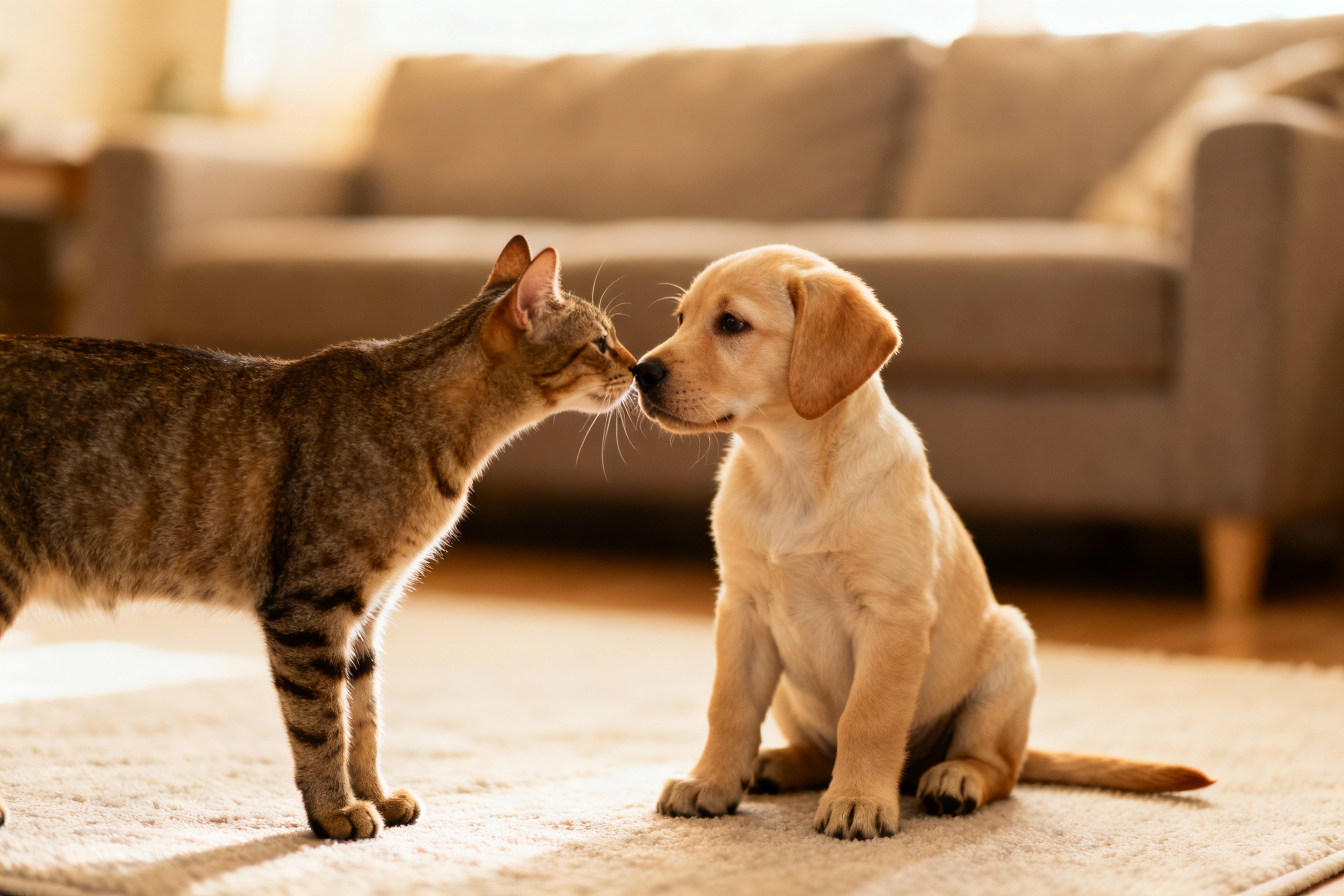
You brought home a bouncy Labrador Retriever puppy and already have a cat who believes the sun revolves around their naps. Can these two live in peace? Absolutely.
But you need a plan, patience, and a sense of humor, because chaos will try to RSVP. Let’s set up your puppy-cat intro so nobody loses whiskers or sanity.
Know Your Players: Labrador Puppy vs. Cat
Labrador puppies mean well, but they come with turbo-charged enthusiasm.
They chase, they mouth, they forget their brakes. Your cat? They appreciate order, routine, and personal space—preferably high up and away from zoomies. Good news: Labs learn fast and love to please.
Cats set clear boundaries. You can use both to your advantage. The goal?
Teach the puppy that the cat is boring to chase and fabulous to ignore.
Prep the House Before the First Hello
Set the environment so the first meetings feel safe—not like a slapstick comedy.
- Create cat-only zones: Give your cat vertical escapes like shelves, a tall cat tree, or a room with a baby gate.
- Separate resources: Keep the cat’s litter box and food in puppy-proof areas. No Lab should “taste-test” clumping litter. Ever.
- Leash and barrier tools: Get a light leash for the puppy and use baby gates or pens for gradual intros.
- Scent swapping: Rub a soft cloth on the cat, then the puppy, and vice versa.
Swap bedding. Let them “meet” by nose first.
Quick Win: Doorway Dining
Feed them on opposite sides of a closed door. Start far from the door and slowly move bowls closer over a few days.
They’ll associate the other’s smell and sounds with mealtime—aka, something good.
The First Meeting: Calm, Short, and Boring (On Purpose)
Keep it so calm it’s almost dull. Boring equals safe in dog-cat diplomacy.
- Exercise the puppy first: Burn energy with a short training session and some fetch. A tired Lab listens better.
Shocker, I know.
- Leash the puppy: Sit or stand with a relaxed grip. Don’t create tension on the leash unless needed.
- Let the cat control the approach: The cat can enter, observe, or bail. Respect the exit.
Zero pressure.
- Reward calm: Mark and treat the puppy for ignoring the cat, looking away, or offering a sit.
- Keep it short: Two to five minutes. End on a win before curiosity becomes chaos.
What to Watch For
- Puppy “good signs”: Soft eyes, sniff-and-look-away, loose body, responding to cues.
- Cat “green lights”: Tail neutral, slow blink, grooming, loafing. Maybe a judgey stare—that’s fine.
- Red flags: Staring, stalking, stiff tail, growling, swatting, or frantic movement.
Pause and reset.
Training Your Lab to Ignore the Cat (Yes, Really)
You’ll teach your puppy that ignoring the cat makes wonderful things happen. Chasing doesn’t.
Build Your Control Cues
- Leave it: Start with treats, then toys, then the cat at a distance. Reward heavily for success.
- Place/Mat: Send your pup to a mat to relax whenever the cat enters.
Treat calmly and often.
- Look at me: Teach a solid eye-contact cue. It’s your emergency brake when curiosity spikes.
Use Barriers to Practice
Put the puppy behind a baby gate and let the cat roam. Reward the puppy for chill behavior.
If the puppy fixates, move farther back and try again. Distance is your friend. IMO: A Labrador who can chill on a mat while the cat struts by deserves a medal. Or at least a peanut butter lick mat.
Protect the Cat’s Sanity (and Whiskers)
Your cat needs control.
You create it.
- Highways up high: Shelves, perches, windowsills—bonus points if they connect across the room.
- Escape routes: Baby gates with cat doors or gates raised 6 inches for under-passes.
- Privacy for essentials: Litter and food in quiet, dog-proof areas. Use covered litter boxes only if your cat already likes them.
- Calming aids: Consider feline pheromone diffusers. They don’t fix everything, but they help, FYI.
Read the Cat Like a Pro
If your cat’s pupils dilate, ears flatten, or tail thrashes, end the session.
If your cat chooses to nap in the same room as the leashed puppy? That’s progress you should celebrate.
Supervised Freedom: Removing the Leash
You’ll get here, but only after multiple calm, uneventful sessions.
- Test the waters: Use a drag line (light leash on the floor) before going fully unleashed.
- Interrupt early: If the puppy looks like they might chase, call them to you and reward. Don’t wait for the sprint.
- Keep sessions short: Ten minutes, tops, with breaks.
Boredom prevents bad decisions.
- End on calm: Always finish with the puppy relaxing on a mat while the cat exists nearby.
Pro tip: If the puppy can’t resist, manage the environment. Doors, gates, crates, and tethers protect training. Management isn’t cheating; it’s smart.
Common Oops Moments (And Fixes)
Stuff happens.
Here’s how to handle it without drama.
- Puppy chases and cat bolts: Calmly call the puppy back, reward, and separate. Next time, more distance and exercise first.
- Cat swats the puppy’s nose: Quick check for scratches, then give both space. Reinforce a wider buffer zone next time.
- Puppy fixates on the cat: Break line of sight with a visual barrier, practice “look at me,” and lower the difficulty.
- Cat hides for days: Increase safe spaces, enrich with play, and slow the pace.
Consider pheromones.
Enrichment: Tire the Pup, Soothe the Cat
A fulfilled dog and a confident cat coexist better than a bored duo plotting chaos.
For the Labrador Puppy
- Mental work: Puzzle feeders, snuffle mats, short training bursts throughout the day.
- Physical outlets: Multiple short play sessions, controlled fetch, gentle tug.
- Chew time: Safe chews while the cat roams, so the puppy associates cat presence with chill vibes.
For the Cat
- Hunting play: Wand toys, laser chases, food puzzles.
- Territory upgrades: Scratching posts, window perches, cozy hideaways.
- Routine: Regular feeding and play times keep stress down. Cats love a schedule like we love Wi-Fi.
Timeline: How Long Does This Take?
Every duo writes their own script. Some settle in two weeks; others need two months.
- Days 1–3: Scent swaps, barrier glimpses, very short leashed sessions.
- Days 4–10: More frequent calm meets, mat work, gate practice, increased cat freedom.
- Weeks 2–4: Drag line sessions, longer coexisting periods, occasional treats for ignoring each other.
- Weeks 4+: Supervised off-leash time, then gradual unsupervised when you’ve had zero incidents.
FYI: Regress if you see chasing, hiding, or stress.
It’s not failure; it’s feedback.
FAQ
Should I let the cat “discipline” the puppy?
A single hiss or air-swat can set a boundary, but don’t rely on the cat to fix puppy behavior. You must manage distance, reward calm, and interrupt chasing early. Protect both parties so nobody learns fear.
What if my Labrador puppy keeps trying to chase?
Increase exercise, step back to gates/barriers, and reinforce “leave it” and “place.” Use higher-value rewards for calm around the cat.
If fixation continues, bring in a certified trainer for tailored help, IMO.
Can I crate the puppy while the cat roams?
Yes, that’s a solid management strategy. Give the puppy a chew or stuffed Kong so the cat’s presence predicts relaxation time. Keep crate sessions short and positive.
Is it okay if they never become best friends?
Absolutely.
Coexistence beats forced friendship. Aim for peaceful parallel lives: puppy relaxes, cat reigns, everyone survives Tuesday. If they end up cuddling later, great—bonus points.
What signs mean I should slow down?
For the puppy: hard staring, whining, lunging, or ignoring cues.
For the cat: hiding, not eating, litter accidents, or aggressive swatting. Any of these mean increase distance, shorten sessions, and sweeten rewards.
My cat swatted and the puppy yelped—did I ruin everything?
No. Pause the session, check for injury, and give both a break.
Next time, start farther apart, leash the pup, and add more mat work. One blip won’t define the relationship.
Conclusion
You can absolutely introduce a Labrador puppy to a cat without chaos becoming your new roommate. Set the stage, move slowly, and reward the heck out of calm behavior.
Manage first, train second, and let their comfort guide the pace. With consistency and a little humor, you’ll go from “zoomies vs. whiskers” to “live and let lounge” in no time.
Leave a Reply