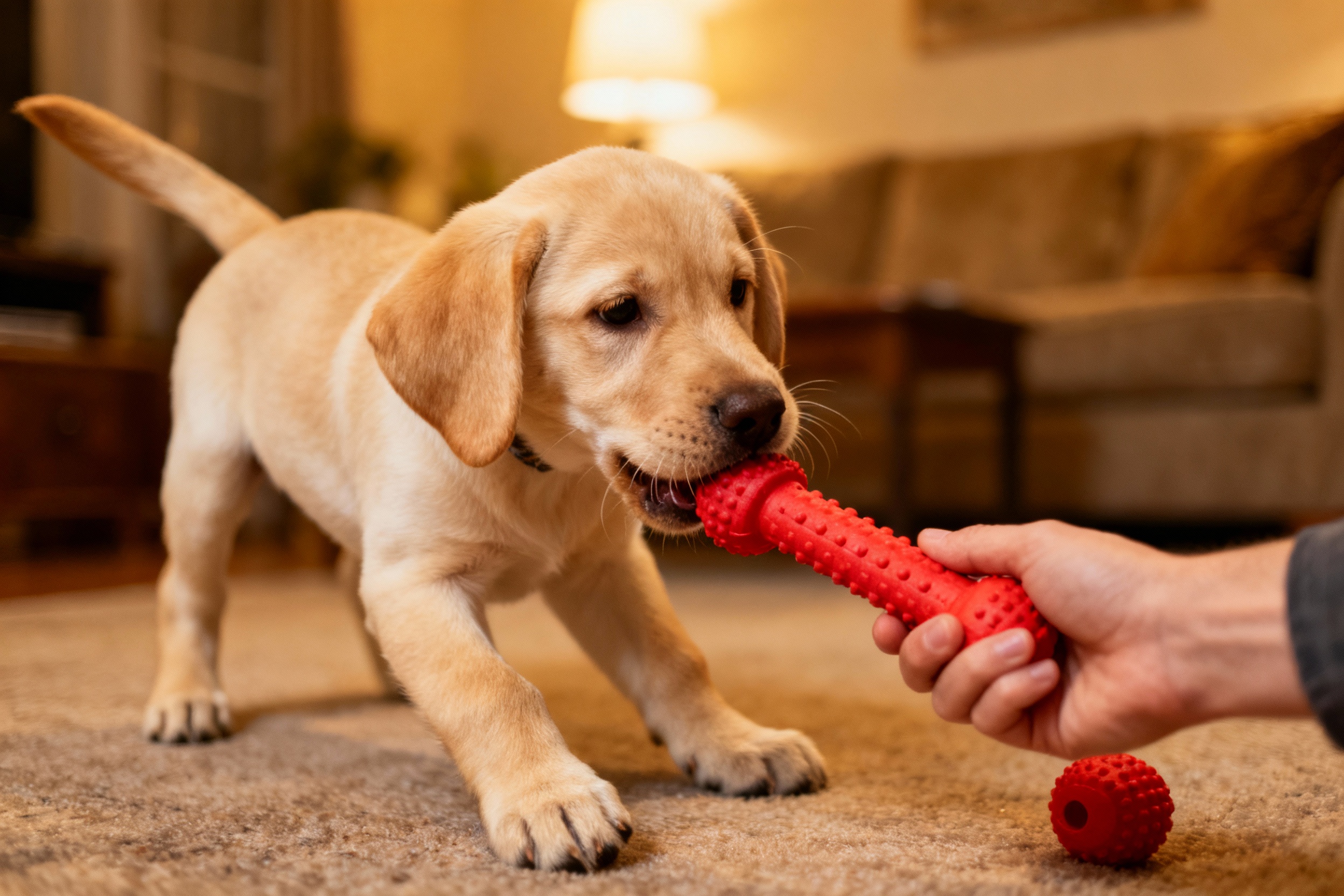
Your Labrador Retriever puppy bites because it works. It gets your attention, it relieves teething pain, and it makes you squeal like a dog toy. The good news?
You can teach bite control fast with clear rules, consistency, and the right toys. Let’s turn those tiny shark teeth into gentle kisses without killing your sanity (or your socks).
Why Lab Puppies Bite (And Why It’s Normal)
Puppy biting isn’t a moral failing. It’s how dogs explore the world, play with littermates, and soothe sore gums.
Labs especially use their mouths a ton because they were bred to retrieve. The trick isn’t to “stop all biting” immediately. You want to teach bite inhibition (gentle mouth) and redirect that energy somewhere appropriate.
That way your Lab learns how to handle pressure, excitement, and human skin without turning into a land piranha.
Set the Rules: What You’ll Allow, What You Won’t
Decide your house rules before chaos hits. Everyone in the family should follow the same plan. Mixed signals confuse puppies fast.
- No teeth on skin: Hands, feet, clothing, hair — off limits.
- Yes to toys: If it squeaks, tugs, or can be chewed, it’s fair game.
- Calm gets attention: Jumping and biting make you stop the fun.
- Short sessions: Puppies fry their brains quickly.
Keep training bursts under 2–3 minutes.
Family Consistency Check
If one person squeals and plays through biting while you step away, the puppy learns to gamble. Guess who loses? You do.
Make a simple cheat sheet for the fridge: “Bite → freeze → redirect → reward.”
The Core Method: Freeze, Redirect, Reward
This is your go-to move. No drama. No lectures.
Just a clean pattern.
- Freeze: Puppy bites? Stop moving your hands and go still. No yelping.
No flailing. Just freeze.
- Redirect: Calmly grab a toy and present it at mouth level. Wiggle it.
Make it fun.
- Reward: When your pup bites the toy, praise warmly and resume play. If they keep going for skin, end the game and turn away for 10–20 seconds.
This teaches: “Teeth on humans ends fun. Teeth on toys makes it awesome.” Dogs repeat what pays.
You’re the bank.
What About the “Yelp” Method?
Some pups get amped when you yelp. Others shut down. IMO, skip it.
Use a calm, neutral freeze instead. It avoids drama and works for most Labradors.
Loaded Toolbox: Give That Mouth A Job
A bored Lab pup will chew your entire life. Give them daily jobs that satisfy the need to bite, tug, and carry.
- Chew rotation: 3–5 safe chews (rubber, nylon, edible).
Rotate daily so they feel “new.”
- Tug toys: Teach “Take it” and “Drop.” Tug rules: low and controlled, with breaks.
- Food puzzles: Kongs stuffed with wet food and frozen, snuffle mats, lick mats. These drain energy quietly.
- Fetch on a schedule: Short, controlled retrieves build good mouth habits and satisfy that retriever brain.
Teething Relief (8–20 Weeks)
Chewing explodes when adult teeth move in. Offer:
- Frozen Kongs with a smear of peanut butter (xylitol-free) or wet food.
- Chilled washcloth (clean, wrung out, knotted, then frozen).
- Soft rubber toys designed for puppies, not adult jaw strength.
FYI, ditch rock-hard chews that could crack teeth.
If it doesn’t dent with a thumbnail, it’s probably too hard.
Train Calm Mouths During Play
Play is where biting erupts, so use it to teach control. You’ll build impulse control without killing the fun.
- Start with a toy: Offer a tug. If teeth touch you, drop the toy, stand up, and pause.
- Restart when calm: Reward stillness with more play.
Boom — your dog learns calm turns the game back on.
- Sprinkle “Sit” or “Down”: Ask for a quick cue mid-play, then release back to tug. Control flips the game back on.
The “Three-Strikes” Rule
If your pup goes for skin three times in a minute, end the session and give a chew in their playpen. Overstimulated puppies don’t learn.
They reboot.
Prevent the Frenzy: Fix the Triggers
Most biting spikes happen at predictable times. Plan for them and you’ll win the day.
- Witching hour (evening zoomies): Schedule a sniffy walk, training game, or frozen Kong before the meltdown.
- Overtired puppy: Naps matter. Young pups need 16–18 hours of sleep.
Cranky pups bite.
- Grabby kids + flappy clothes: Dress the puppy in structure instead of chaos. Use gates, pens, and a leash drag line indoors.
- Under-exercised brain: Do 5-minute training bursts (name game, sits, hand target, “leave it”) throughout the day.
Leash the House (Temporarily)
Clip a lightweight house line to your pup. When biting kicks off, calmly step on the line, guide them away, and redirect to a toy.
No chasing. No wrestling matches. Just smooth redirection.
Teach Bite Inhibition on Purpose
We’re not just blocking biting; we’re teaching gentleness.
Here’s a simple exercise:
- Hold a treat in a closed fist at your pup’s nose level.
- They lick, nibble, or paw? Keep the fist closed.
- They back off or lick gently? Yes! Open your hand and feed.
- Add the cue “Gentle.”
Repeat daily for a week. You’re shaping a soft mouth.
This skill translates to taking toys, treats, and — eventually — your sleeve without chomping.
Hand Target Game
Teach your pup to boop your palm with their nose on cue (“Touch”). It gives them a go-to behavior around hands and reduces uncertainty. Hands become a target to bump, not a snack.
What Not To Do (Because It Backfires)
Some common “fixes” cause bigger problems.
Skip these, IMO:
- No muzzle grabs, alpha rolls, or “shut” commands: They scare puppies and can create defensive biting.
- No rough smacks or pushing the mouth: Touch pressure can excite, not suppress.
- No bitter sprays on hands: You need your hands to mean good things.
- No unsupervised rough play with kids: Manage first, teach skills second.
FAQs
When will my Lab puppy stop biting?
Most Labs improve by 5–6 months, with teething peaks around 3–5 months. The behavior fades faster when you stay consistent with freeze–redirect–reward and give daily chew outlets. Expect hiccups during growth spurts and over-tired evenings.
Is my puppy aggressive?
Probably not.
Puppy biting usually equals overarousal, teething, or play. True aggression shows stiff body language, hard staring, and low growls in non-play contexts. If you feel uneasy, record a short video and consult a certified trainer.
Better safe than sorry.
What toys work best for biting?
Use a mix: soft puppy rubber (for teething), rope tugs (supervised), stuffed Kongs, and fetch dummies. Rotate them. Keep a toy on you to redirect fast.
If the toy slips out of their mouth easily, it’s great for trading and reinforcing “Drop.”
Should I let my puppy bite during play sometimes?
No teeth on skin, ever. That rule keeps things crystal clear. Allow all the biting on toys and chews.
You’ll still raise a gentle-mouthed Retriever, just without the accidental velociraptor moments.
How much exercise does a Lab puppy need?
Think “brain first, body second.” Several 5–10 minute training bursts, scatter feeding, and sniffy walks beat one long, wild sprint. As a rough guide: 5 minutes of structured activity per month of age, 2–3 times daily, plus free play and naps. Avoid forced, repetitive impact until growth plates close.
What if my puppy won’t stop even after redirection?
End the session calmly.
Pop them behind a baby gate or in a playpen with a chew for 5–10 minutes. Overaroused puppies need decompression, not more coaching. After the reset, reintroduce a calmer game.
Wrap-Up: Gentle Mouths, Happy Hands
Your Lab puppy isn’t trying to be a menace — they’re a baby with a mouth and big feelings.
Set the rules, keep responses boring and consistent, and give that mouth plenty of legal outlets. In a few weeks, you’ll see fewer shark attacks and more self-control. And hey, your socks might even survive.
FYI: consistency beats cleverness every time.
Leave a Reply