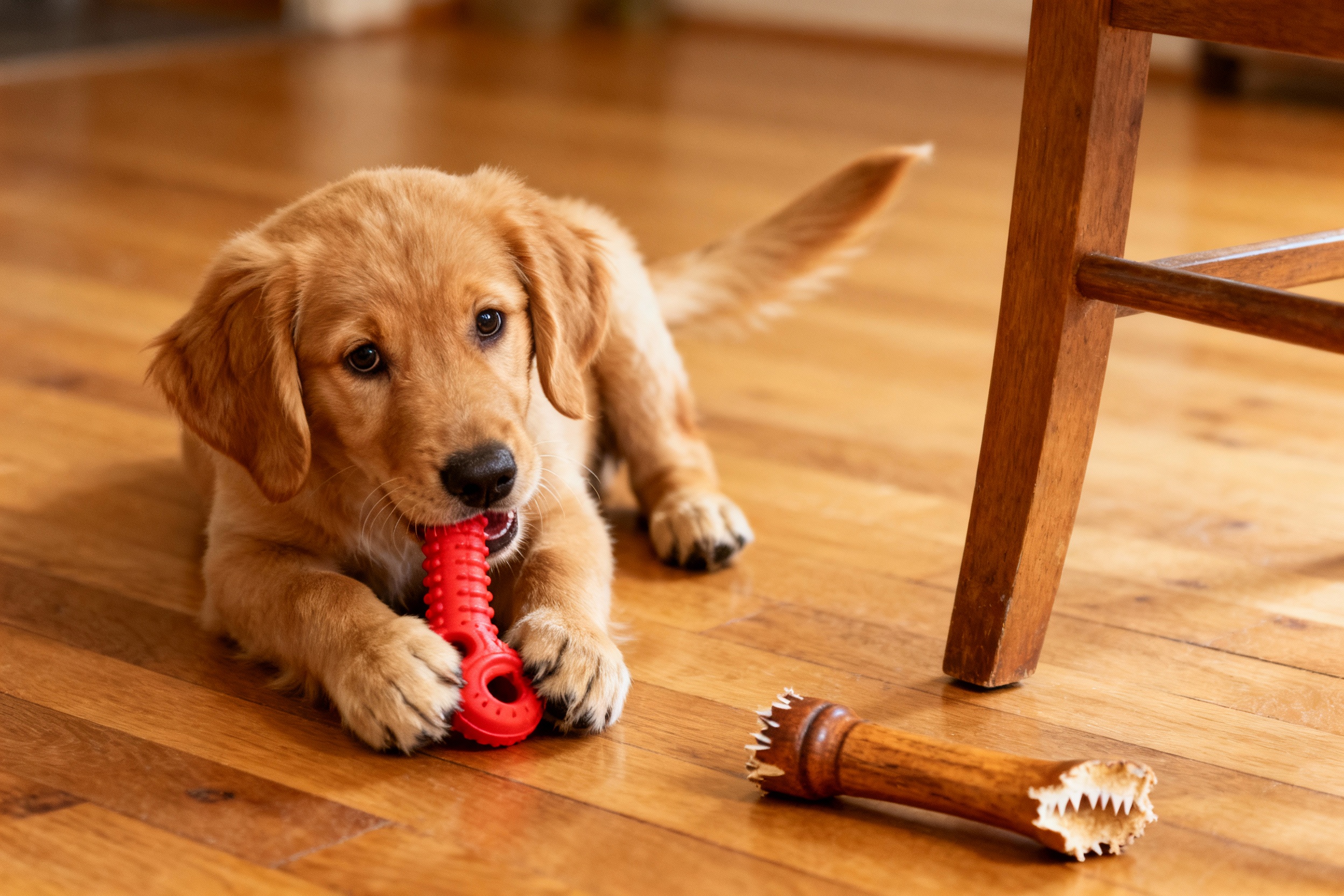
Your golden retriever puppy isn’t plotting your demise by sofa destruction—promise. Chewing is normal, especially when those sharky little puppy teeth are coming in. But normal doesn’t mean you have to accept shredded chair legs as “boho chic.” Let’s walk through exactly how to stop the furniture gnaw-fest and channel that chewing into stuff you actually want them to chomp.
Understand Why Your Golden Chews Everything

Puppies chew for three big reasons: teething, boredom, and stress.
Golden retrievers also love to carry and mouth things—it’s in their genes. You didn’t adopt a couch-eater, you adopted a retriever. When you know the why, you can fix the how. Teething peaks around 4–6 months, but the mouthy behavior can linger without guidance.
So yes, this is a phase, but it needs management.
Puppy-Proof Like You Mean It
You can’t train what you don’t prevent. Give your puppy fewer bad choices.
- Block access to high-risk zones with baby gates or pens when you can’t supervise.
- Hide tempting objects: remotes, shoes, kids’ toys—anything that smells like you.
- Use furniture guards like washable slipcovers or corner protectors during training.
- Secure cables with cord covers; no one wants a shock-filled chew toy.
FYI: Management isn’t “cheating.” It’s smart. You protect your furniture while your puppy learns.

Give Chewing a Legal Outlet
Your puppy must chew.
So give them stuff that feels better than wood and upholstery.
- Teething toys with different textures. Rubber, rope, and nylon are your friends.
- Frozen options: wet a washcloth, twist it, freeze it, and let them gnaw. Instant gum relief.
- Edible chews like bully sticks or Himalayan chews.
Supervise and size appropriately.
- Food puzzles and stuffable toys (Kongs with frozen yogurt or peanut butter—xylitol-free!) to keep their brain busy.
How Many Toys Do You Actually Need?
Rotate 5–7 “active” toys and stash the rest. Novelty keeps interest high. If the same squeaky dinosaur has been out for two months, it’s background noise.
Train a Rock-Solid “Trade” and “Leave It”
These two cues stop disasters before they happen and save your socks.
And your sanity.
- Trade: Offer a high-value treat, say “trade,” and present it at your puppy’s nose. When they drop the item, mark it (say “yes!”), give the treat, then give a chew toy. Repeat until they light up when you say “trade.”
- Leave it: Hold a treat in a closed fist.
Puppy sniffs/licks—nothing happens. The moment they look away, mark and reward from your other hand. Build up to placing a low-value item on the floor, then household stuff.
They learn ignoring gets rewards.
What to Do When You Catch Them Chewing Furniture
Don’t yell. Don’t chase. You’ll make the chair more exciting.
- Say “uh-uh” or “hey” to interrupt.
- Guide them away, ask for “trade,” and hand over a chew toy.
- Praise like they just solved world peace when they chew the correct thing.
Consistency turns “oops” into “nailed it.”

Burn That Golden Energy (Or Else)
A tired golden is a well-behaved golden.
Chewing often screams, “I’m bored!”
- Short training bursts: 5 minutes, 3–4 times daily. Sit, down, stay, recall. Mental exercise drains energy fast.
- Sniffari walks: Let them sniff.
Scent work tires brains more than a sprint.
- Play with structure: Tug with rules (start/stop cue), fetch with “drop,” and quick hide-and-seek indoors.
- Meals in puzzles: Ditch the bowl. Work for food = less time for furniture.
IMO, 70% of “chewing problems” vanish when you boost enrichment.
Make Furniture Taste Terrible (Strategically)

Bitter sprays can help, but use them as a backup—not your only plan.
How to Use Deterrent Sprays
- Test on a tiny, hidden spot first. Some finishes don’t love sprays.
- Clean the area so smells don’t attract your puppy.
- Apply the deterrent, then show the puppy an allowed chew immediately after.
Redirect every time.
- Reapply every few days until the habit changes.
Some puppies think bitter apple is a tasty cocktail. If that’s yours, try different brands or go heavier on management and redirection.
Set a Routine That Prevents Oops Moments
Puppies thrive on predictable rhythms. Your couch does, too.
- Crate or pen time after play and before naps.
Give a safe chew inside so the crate feels like “chew zone = chill zone.”
- Supervised free time only when you can watch. If you can’t watch, use barriers or tether the puppy to you with a leash.
- Chew windows after meals and walks. Offer legal chews proactively so they don’t go hunting.
Signs Your Puppy Needs a Break
Zoomies, bitey behavior, “random” chewing, ignoring cues—all red flags for overtiredness.
Pop them in the crate with a chew and a cover over the top. Ten minutes later? Angel dog.
Fix the Root Causes Fast
If chewing continues despite your A+ effort, check these:
- Teeth and gums: Retained baby teeth or sore gums can crank up chewing.
Ask your vet to peek.
- Diet: Make sure they eat a balanced puppy formula. Underfed pups scavenge more.
- Anxiety: Destruction only when alone? You may have separation issues.
Get help early—don’t wait.
IMO, contacting a certified trainer sooner rather than later saves money and furniture. And nerves.
Common Mistakes to Avoid
- Punishing after the fact: Dogs don’t connect your lecture with the crime. They just learn you’re scary near chewed stuff.
- Free-roaming too soon: Gradually earn freedom room by room.
- Inconsistent rules: If old shoes are toys, new shoes are fair game.
Keep the rules clear: human stuff is off-limits.
- Underestimating teething: Plan for it. Ice, frozen chews, and gentle gum relief are not optional.
Sample Daily Game Plan
Morning:
- Short potty and sniff walk
- 5-minute training + breakfast in a puzzle
- Supervised play with a tug/fetch session
- Crate with a frozen Kong for a nap
Afternoon:
- Potty + sniff walk
- Chew time with a safe edible chew
- Calm indoor play + place training
Evening:
- Dinner in a snuffle mat
- Family hangout with tethered supervision
- Quiet crate time before bed with a soft chew
FAQ
When will my golden retriever puppy stop chewing everything?
Teething eases by 6 months, but curiosity chewing can last up to 12–18 months. With good management and training, the intense phase fades fast.
Keep reinforcing good habits and you’ll see steady improvement.
Are rawhide chews safe for puppies?
I’d skip traditional rawhide. It can swell, splinter, and cause blockages. Choose digestible alternatives like bully sticks, collagen chews, or vet-approved dental chews, and always supervise.
What if my puppy only chews furniture when I’m gone?
That may be separation-related distress.
Start with gradual alone-time training, safe confinement (crate or puppy-proofed room), and a high-value frozen food toy only given when you leave. If signs persist—howling, drooling, destruction—consult a trainer or vet.
Do deterrent sprays actually work?
Sometimes. They help when paired with redirection and management.
If your puppy doesn’t mind the taste, don’t force it—switch tactics and double down on supervision and better chew options.
How many chew sessions per day are ideal?
Aim for 3–4 short chew sessions, especially after meals and walks. Rotate textures so the novelty stays high, and keep sessions supervised until the habit sticks.
Is crate training necessary to stop chewing?
Necessary? Not always.
Hugely helpful? Yes. Crates or pens create calm, safe downtime and stop rehearsals of bad habits.
Pair the crate with chews so it feels like a cozy chew lounge.
Conclusion
You won’t “willpower” a golden puppy out of chewing—you’ll guide it. Manage the environment, stack the deck with awesome chew options, train “trade” and “leave it,” and burn off that golden energy. Do those things consistently, and your furniture will survive puppyhood with only minor battle scars.
And hey, you might even enjoy the process—once your couch stops being the appetizer.
Leave a Reply