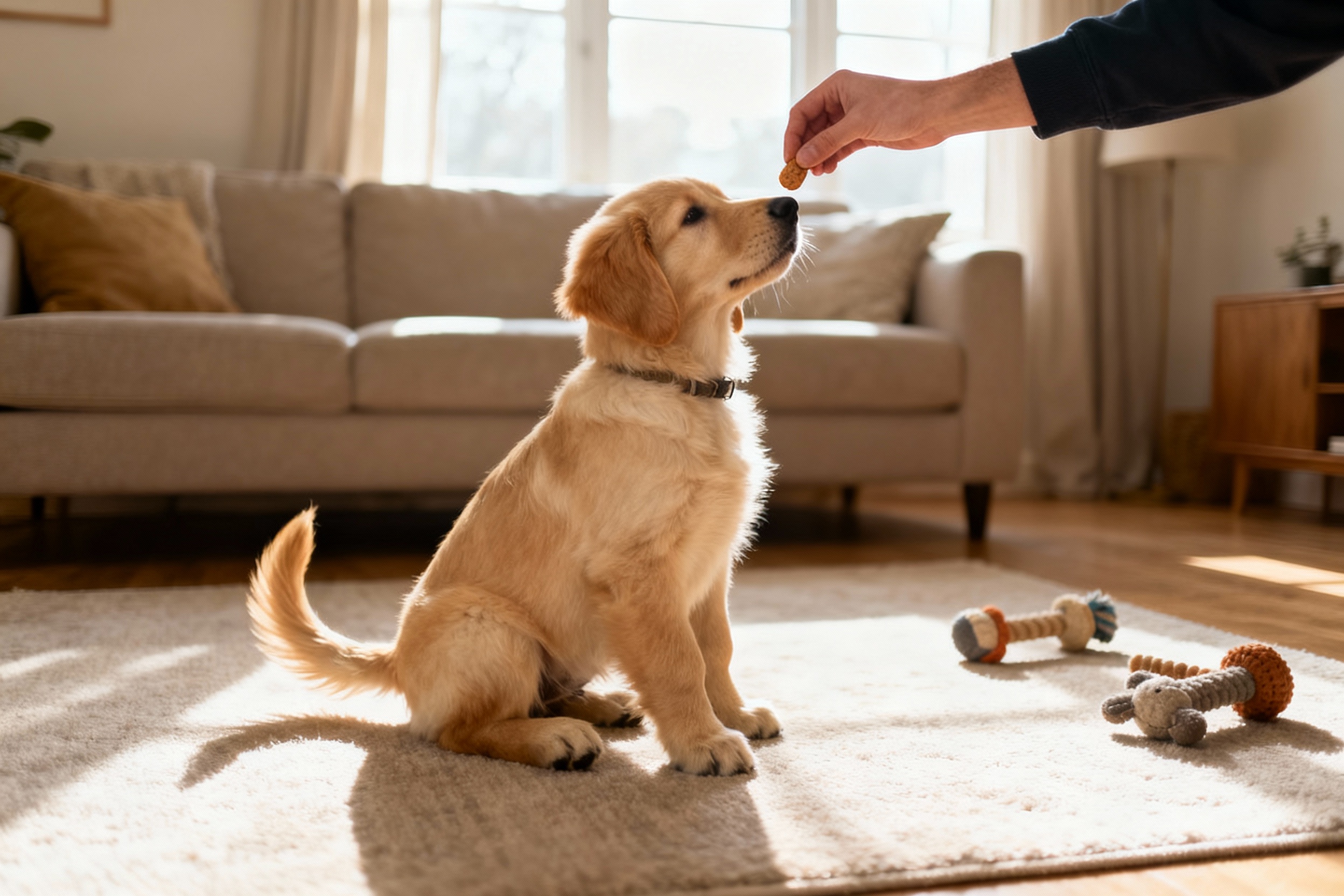
That golden blur zooming through your living room? That’s your new Golden Retriever puppy—and yes, they’re as smart and sweet as everyone says. But they’re also part toddler, part vacuum, and part parkour athlete.
The good news: you can train your golden at home without losing your sanity or your socks. Ready to turn chaos into charm? Let’s do this.
Set the Stage: Routines, Boundaries, and the Right Gear

Your puppy doesn’t magically know the rules.
You create them. Start with a simple routine that includes potty breaks, meals, naps, play, and short training sessions. Must-have training gear:
- Crate that fits them now and later (with divider)
- Leash and flat collar or harness (no choke/prong collars for puppies)
- High-value treats (pea-sized, soft, and smelly)
- Chew toys (rubber, nylon, and a plush or two)
- Baby gates for managing access
Keep rules the same for everyone in the house. If one person lets the puppy on the couch and another says no, your golden will pick the person with the weakest resolve.
Obviously.
Potty Training Without Tears (or Carpet Cleaner)
Golden pups learn fast if you set them up to win. The formula looks boring, but it works. Follow the clock:
- First thing in the morning and last thing at night
- After meals, naps, and play sessions
- Every 1–2 hours for young pups
Take your puppy to the same spot and stand still. Say a cue like “go potty” softly.
When they finish, party. Treats and praise within two seconds. Then go back inside so they learn potty time not equal play time.
Crate Training = Your Sanity Saver
Use the crate for naps and overnight.
Make it cozy, not scary. Feed meals in the crate, toss treats inside, and leave the door open at first. If they whine, let them settle a bit before letting them out so whining doesn’t become their “open sesame.” Accidents happen.
Clean with enzymatic cleaner only. If you catch them mid-squat, interrupt gently and go outside fast. No scolding—goldens want to please, but they don’t understand lectures.

Teach the Core Cues Early
Start with five essentials and keep sessions short—2 to 5 minutes, 2 to 5 times daily.
End while your puppy still wants more. Top five cues:
- Name: Say it once, mark with “Yes!” when they look, treat. Make their name a jackpot, not background noise.
- Sit: Lure with a treat from nose to forehead, mark when their butt hits floor, reward.
- Down: From sit, lure to the ground slowly. Reward the moment elbows touch.
- Come (recall): Use a long line.
Say “Come!” once, then praise like a maniac when they rocket in. Treat big.
- Leave it: Cover a treat in your fist. When they stop pestering, mark and reward with a different treat.
Self-control = gold.
Leash Manners for the Wiggle Monster
Puppies pull because the world smells like snacks. Start indoors. Every time the leash goes slack, mark “Yes!” and give a treat at your knee.
Step forward only when the leash stays loose. If they pull, stop and wait—trees move faster than you if you let them.
Bitey Crocodile Phase: Handle With Humor and Strategy
Puppy teeth feel like sewing needles, and your golden will chew everything because teething hurts and life is interesting. You can survive this. Redirect, don’t scold:
- Offer a chew toy anytime they mouth skin, sleeves, or ankles.
- Use frozen washcloths or puppy-safe rubber toys for teething relief.
- End play briefly if they get overexcited—30 second time-out behind a gate works wonders.
Teach “drop it” with trades.
Say “drop,” hold a treat to their nose, reward when they release, then give the item back sometimes. This builds trust so they don’t guard.
Grooming and Handling Without Drama
Goldens need brushing, nail trims, and ear checks. Teach them to love it.
- Touch paws, ears, tail lightly.
Treat each touch.
- Pair the brush with peanut butter on a lick mat.
- Clip one nail, treat, and quit. Progress beats perfection.
Socialization: The Golden Superpower
Goldens thrive when you show them the world early and positively. The “socialization window” peaks before 16 weeks, so start now—safely. Make a checklist:
- People with hats, glasses, beards
- Other friendly dogs and calm older dogs
- Wheelchairs, bikes, strollers, umbrellas
- Surfaces: metal grates, grass, tile, wood
- Sounds: vacuum, blender, doorbell, thunder recordings
Keep vaccine status in mind.
Choose clean, controlled environments. Pair every new thing with treats and distance. If your puppy looks unsure, back up, feed, and go slower.
FYI, “flooding” does not build confidence—choice does.
Meeting Dogs the Right Way
Pick polite canine greeters. Short hello on loose leashes, count to five, then call your pup back to you for a treat. Repeat.
You teach that checking in with you pays better than roughhousing.
House Manners: Jumping, Begging, and Door Dashes

Goldens jump because it works. Remove the payoff and reward alternatives. For jumping:
- Turn slightly away, no eye contact when paws leave the ground.
- Mark and reward four-on-the-floor or a sit.
- Coach guests before they enter. Consistency or chaos—your call.
For begging:
- Feed meals on a mat while you eat.
Reward staying on the mat.
- Never feed from the table. Not even once. They remember.
For door dashes:
- Teach “wait” at thresholds.
Door opens a crack only if they sit.
- Release with “okay,” then close the door if they bolt forward. Clear cause and effect.
Enrichment That Tires the Brain (aka Peace and Quiet)
A bored golden invents hobbies. You won’t like them.
- Scatter feeding or snuffle mats
- Frozen Kongs stuffed with kibble and yogurt
- Short scent games: hide treats around one room
- Basic trick training: spin, touch, roll over
Mental work tires puppies faster than endless fetch, IMO.
Build Reliability: Proofing and Real-Life Practice
Once your puppy nails cues at home, don’t declare victory.
Teach them that “sit” means sit anywhere. Proof like a pro:
- Change one variable at a time: location, distance, distractions.
- Use a sliding pay scale: bigger rewards for harder situations.
- Practice micro-sessions everywhere—mailbox, sidewalk, parking lot.
For recall, use a long line at parks. Call once, then jog backward, cheer, and pay big when they land in front of you. Sometimes release them back to play so “come” doesn’t always end the fun.
Common Mistakes to Avoid
- Overtraining: puppies fade fast.
Quit while they’re still engaged.
- Repeating cues: say it once, then help them succeed.
- Using punishment: it damages trust and confuses soft, people-pleasing goldens.
- Ignoring exercise: balanced physical and mental activity prevents mischief.
Sample Daily Schedule (Adjust for Age)
Mornings and evenings usually hold the most energy. Rotate rest and activity to avoid the zoomie-gremlin hours.
- 7:00 – Potty, short walk or play, breakfast in crate
- 8:00 – Nap (crate)
- 10:00 – Potty, 5-minute training, chew time
- 12:00 – Potty, lunch on snuffle mat, nap
- 2:00 – Potty, socialization outing or car ride, calm exposure
- 4:00 – Potty, play + training (recall, leave it)
- 6:00 – Dinner, enrichment toy, nap
- 8:00 – Potty, cuddle/brush, settle on mat
- 10:00 – Final potty, bedtime
FYI: growth spurts and teething weeks can throw schedules off. You’re not failing; your puppy’s brain is buffering.
FAQ
When should I start training my Golden Retriever puppy?
Immediately.
Training starts the second they walk in the door. Keep it fun and tiny at first—think 2–3 minute bursts. Even an 8-week-old can learn sit, name, and gentle handling.
How do I stop my puppy from chewing everything?
Manage the environment and meet their chewing needs.
Use gates, pick up tempting items, and offer 3–4 types of chews daily. Redirect every time they pick the wrong thing, and praise like crazy when they choose their toys.
What treats work best for training?
Soft, pea-sized, and smelly. Think tiny bits of chicken, cheese, or commercial training treats.
Save the top-tier stuff for tough moments like recall outside or ignoring squirrels.
How much exercise does a Golden Retriever puppy need?
Short, age-appropriate bursts. Use the “5-minute rule”: roughly 5 minutes of structured exercise per month of age, twice daily, plus free play and mental work. Avoid long runs or stair marathons until growth plates close.
My puppy ignores me outside.
Help?
You tried to skip levels. Go back to basics with a long line, increase reward value, and practice in low-distraction areas first. Gradually add distractions and pay big when they check in or come when called.
Do I need a professional trainer?
Not mandatory, but a positive reinforcement trainer helps a ton, especially for first-time puppy parents.
Group puppy classes also boost social skills and provide structured practice. Worth it, IMO.
Wrapping It Up
Training your Golden Retriever puppy at home doesn’t need to feel like a full-time job. Keep sessions short, keep rewards tasty, and keep your sense of humor.
If you focus on routines, socialization, and simple cues, you’ll raise a well-mannered golden who still brings the goof in the best way. You’ve got this—and your couch might even survive.
Leave a Reply