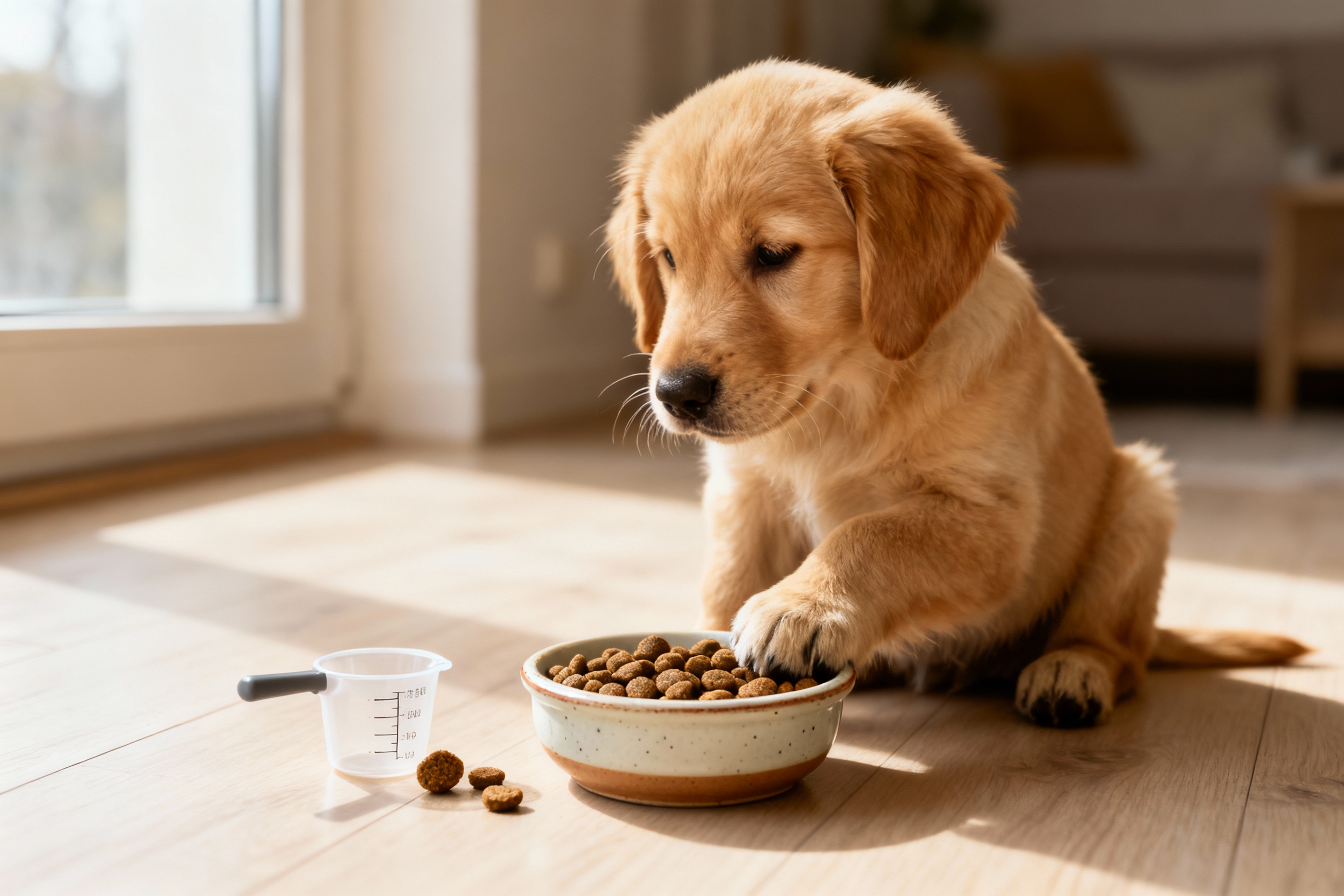
Golden Retriever puppies act like living vacuum cleaners with paws. They’ll eat anything that smells vaguely edible—and some stuff that doesn’t. But how much should you actually feed that fluffy nugget?
Let’s keep your pup full, growing strong, and not morphing into a walking marshmallow.
Why Golden Retriever Puppies Need A Feeding Plan

Golden pups grow fast, like “new shoes every month” fast. Their bones, joints, and immune systems need the right fuel at the right time. Overfeeding can cause rapid growth and joint issues; underfeeding can stunt development and energy.
The goal? Slow, steady growth and visible waistline—not a stuffed potato with legs.
How Much To Feed: The Quick-Start Guide
Every puppy is different, but here’s a solid baseline for a typical Golden Retriever puppy on a quality large-breed puppy food. Always check your brand’s feeding chart and adjust from there.
- 8–10 weeks: 1.5–2.5 cups per day, split into 3–4 meals
- 3–4 months: 2–3 cups per day, split into 3 meals
- 5–6 months: 2.5–3.5 cups per day, split into 2–3 meals
- 7–12 months: 3–4 cups per day, split into 2 meals
These amounts assume a standard kibble with about 350–420 kcal per cup. Higher-calorie foods = fewer cups. Lower-calorie foods = more cups.
Always feed calories, not just “cups.”
Use Calories, Not Just Cups
Check the bag for calories (kcal per cup). A typical Golden puppy needs roughly:
- 8–12 weeks: 900–1,200 kcal/day
- 3–6 months: 1,100–1,600 kcal/day
- 6–12 months: 1,200–1,700 kcal/day (depends on activity and size)
If your pup zooms like a tiny athlete, bump it up a bit. If they resemble a plush ottoman, dial it back.
Easy.

Meal Frequency: Timing Matters
Puppy tummies prefer smaller, frequent meals. It keeps energy stable and prevents scarf-and-barf situations.
- 8–12 weeks: 3–4 meals/day
- 3–6 months: 3 meals/day
- 6–12 months: 2 meals/day
Snack Strategy
Treats count. Keep treats to under 10% of daily calories.
Training often? Use part of their kibble as rewards. Your future adult dog’s waistline will thank you, IMO.
Large-Breed Puppy Food: Non-Negotiable
Goldens qualify as a large breed, which means you need large-breed puppy formula until about 12–18 months.
Why? It controls calcium and energy to reduce risks of hip dysplasia and joint problems. Regular puppy food can push growth too fast.
Look for:
- AAFCO growth or all life stages with large-breed claim
- Calcium: ~1.2% (0.8–1.5% acceptable)
- Calcium:Phosphorus ratio: around 1.2–1.4:1
- Protein: 26–30% is typical and safe
Wet vs Dry vs Raw
– Dry food is easiest for measuring, storage, and dental health (somewhat). – Wet food works for picky eaters but watch calories. – Raw/home-cooked? Great if formulated by a board-certified veterinary nutritionist. Random recipes online = nutritional roulette, FYI.

How To Tell If You’re Feeding The Right Amount
Your best tool isn’t a measuring cup—it’s your eyes and hands.
- Ribs: You should feel them easily with light pressure, but not see them sharply.
- Waist: Visible tuck when viewed from above.
No barrel shapes.
- Energy: Bright eyes, playful, not lethargic or wired from hunger.
- Poops: Firm, log-shaped, 1–3 times/day. Loose stool or huge piles? You might be overfeeding or need a diet change.
Adjusting Intake
– Too chunky? Reduce by 10–15% for 1–2 weeks and recheck. – Too lean? Increase by 10–15%. – Growth spurts happen.
Reassess monthly and after major activity changes.
Real-Life Feeding Examples

Here are sample daily amounts for a typical large-breed puppy kibble at ~380 kcal/cup. Adjust to your pup’s behavior and body.
- 10-week, 15 lb pup: 2 cups/day (split 3–4 meals)
- 4-month, 25 lb pup: 2.5–3 cups/day (3 meals)
- 6-month, 45 lb pup: 3–3.25 cups/day (2–3 meals)
- 9-month, 55 lb pup: 3.25–3.75 cups/day (2 meals)
If your food lists 430+ kcal/cup, subtract a bit. If it lists 320 kcal/cup, add a bit.
You get the idea.
Feeding Tips That Save You Headaches
– Use a scale. Weigh the food for accuracy. Cups lie. A $10 kitchen scale never does. – Set meal times. 15–20 minutes to eat, then pick up leftovers.
Free-feeding leads to chubby pups. – Control growth. Not skinny, not chunky. Slow and steady lowers joint stress. – Keep water available. Hydration helps digestion and keeps zoomies safe. – Transition foods slowly. 7–10 days, increasing new food gradually to avoid tummy drama. – Watch the extras. Peanut butter, cheese, and table scraps add stealth calories. Delicious, yes.
Helpful? Not really.
When To Switch To Adult Food
Transition around 12 months for many Goldens, or up to 18 months if your vet suggests it. Choose a quality large-breed adult formula and switch over 7–10 days.
If your pup still looks very lean and leggy at 12 months, give it a bit longer on puppy food—but check with your vet.
Common Mistakes (And Easy Fixes)
- Overfeeding because “he looks hungry.” Goldens always look hungry. Use body condition, not puppy eyes.
- Ignoring the bag’s calorie info. Cups vary wildly. Check kcal/cup.
- Too many treats during training. Replace some meals with training kibble.
Same calories, more learning.
- Skipping large-breed puppy food. That one matters for joints, full stop.
- Sudden food switches. Tummy turmoil follows. Go slow.
FAQ
How often should I feed my Golden Retriever puppy?
Feed 3–4 times daily until 12 weeks, 3 times daily until 6 months, then 2 times daily after that. Smaller, frequent meals help digestion and keep energy smooth.
Should I leave food out all day?
No.
Goldens aren’t exactly known for moderation. Scheduled meals help you control calories and monitor appetite, which can flag health issues early.
What if my puppy has soft stool?
First, reduce the total food by about 10% and see if it firms up in a few days. If not, consider a slower food transition, check treat overload, and ensure you use a reputable large-breed puppy formula.
Persistent diarrhea or lethargy? Call your vet, IMO.
Can I feed homemade or raw?
You can—but only if a board-certified veterinary nutritionist formulates it. Puppies have razor-thin margins for calcium and other nutrients.
Guesswork can cause lifelong issues. If you want fresh food, look for brands with veterinary nutrition oversight and full nutrient profiles.
When do I switch to adult food?
Most Goldens switch between 12–15 months. If your pup still looks very lanky, wait a bit longer.
Transition gradually over 7–10 days to avoid GI upset.
How do I know I’m feeding the right amount?
Feel the ribs with light pressure, see a waist from above, and watch for steady energy. If your pup looks padded and breathes hard after light play, feed less. If you can count ribs from across the room, feed more.
Bottom Line
Feed your Golden Retriever puppy enough to grow strong, not fast.
Use a large-breed puppy formula, measure by calories, and adjust based on body condition. Keep treats modest, meals consistent, and changes slow. Do that, and you’ll raise a healthy, happy goofball with a great waistline and even better zoomies—FYI, that’s the dream.
Leave a Reply