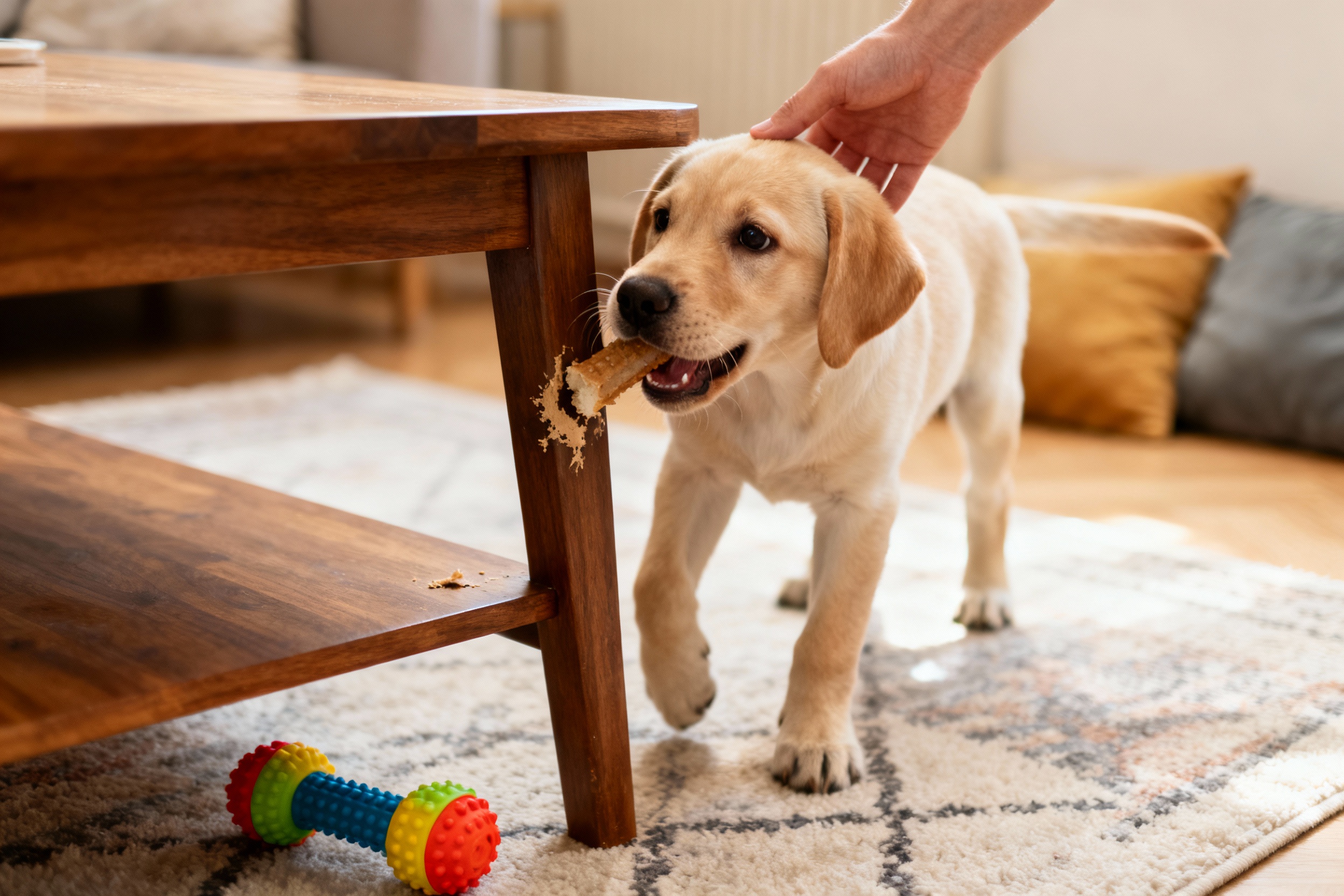
Your Labrador Retriever puppy isn’t trying to ruin your life—or your coffee table. Chewing is how puppies explore, soothe teething pain, and burn energy they don’t know what to do with yet. The good news?
You can channel that chomp-happy energy away from your furniture and into better habits. Let’s make your couch boring and your puppy happy.
Understand Why Your Lab Chews
Labradors are mouthy by design. They’re retrievers, so carrying, mouthing, and chewing feel natural—like breathing.
Add teething (usually 3–6 months) and you’ve got a perfect storm for gnawing on chair legs. Chewing helps:
- Relieve teething discomfort
- Reduce boredom and anxiety
- Explore new textures and tastes
When you know the “why,” the “how to stop it” gets way easier.
Manage the Environment (AKA Save Your Furniture)
You can’t train what you can’t supervise. Management keeps your puppy from rehearsing bad habits.
- Puppy-proof the zone: Keep shoes, cords, and tempting chewables out of reach. If it fits in a puppy’s mouth, it’s fair game—FYI.
- Use gates and pens: Create safe spaces where your pup has approved chew toys only.
- Crate for short stints: A crate helps when you can’t watch them.
Make it comfy with a chew-safe toy.
- Furniture deterrent sprays: Bitter apple or citrus sprays can help, but test first. Some pups treat them like salad dressing.
Pro Tip: Rotate Toys
Keep 4–6 chew toys and rotate them every couple of days. Novelty keeps your Lab interested in the right things.
Give Better Chew Options (And Make Them Irresistible)
Your puppy needs legal outlets for those jaws.
Offer a variety so they don’t go hunting for new thrills on your coffee table. Great chew options:
- Rubber chew toys: Think KONGs or similar, sized for puppies.
- Frozen washcloths: Wet, twist, freeze. Magic for teething gums.
- Edible chews: Yak chews, puppy-safe dental sticks. Supervise, always.
- Rope toys: Good for supervised play; remove if strands fray.
Stuff It, Freeze It, Love It
Stuff a KONG with soaked kibble, banana, pumpkin, or a smear of xylitol-free peanut butter.
Freeze it. You get 20–30 glorious minutes of peace while your puppy works for the reward. It’s enrichment plus teething relief—IMO, unbeatable.
Train the Trade: “Drop It” and “Leave It”
Training solves 80% of furniture-chewing drama.
Teach your pup what to do instead of hoping they stop.
“Drop It” (for when they already grabbed a shoe)
- Offer a trade: a tasty treat or a more exciting toy.
- Say “Drop it” once. Hold the treat near their nose.
- When they drop the item, mark it with “Yes!” and reward.
- Give the item back if it’s their toy. Keeps the game fair.
Repeat daily with toys, then level up to low-value household items (under supervision).
“Leave It” (for prevention)
- Hold a treat in a closed fist.
Pup sniffs, licks, whines—ignore.
- When they back off, say “Yes!” and reward from the other hand.
- Place a treat on the floor covered by your hand. Uncover briefly when they wait.
- Practice around table legs and baseboards with rewards for ignoring.
Key idea: Reinforce calm choices. Your Lab will repeat whatever gets them paid.
Burn That Energy (A Tired Pup Chews Less)
Chewing often screams, “I’m bored.” Labs have big brains and bigger energy tanks.
Empty those tanks.
- Short training bursts: 5 minutes of sit, down, stay, recall. Brain work tires them out faster than fetch.
- Sniffari walks: Slow walks with sniffing rights. Sniffing lowers stress and provides enrichment.
- Food puzzles: Snuffle mats, treat balls, slow feeders—turn mealtime into a job.
- Appropriate play: Tug with rules (start and stop cues), gentle fetch on soft surfaces.
Age-Appropriate Exercise
Puppy joints need care.
Use the 5-minute rule: about 5 minutes of structured exercise per month of age, up to twice a day. Free play on grass? Great.
Half-marathon? Hard pass.
Interrupt, Redirect, Praise
Catching them in the act? Don’t scold.
Don’t shout. Don’t make it a soap opera.
- Interrupt: Clap once or say “Ah-ah” calmly.
- Redirect: Offer a chew toy or frozen KONG immediately.
- Praise: When they chew the right thing, celebrate like they solved world peace.
Consistency wins. If your puppy learns “chewing furniture = boring, chewing my toy = party,” they’ll choose the party every time.
Set Routines and Prevent Overstimulation
Puppies spiral when tired or overstimulated—just like toddlers.
Structure keeps everyone sane.
- Daily rhythm: Potty, play, train, chew time, nap. Repeat.
- Calm zones: After play, settle your pup with a chew in their crate or pen.
- Chew windows: Offer the best chews during peak chewing times (typically evenings).
Chew Markers and Boundaries
Apply safe deterrent spray on furniture legs consistently for 1–2 weeks while reinforcing chew toys. Add puppy-safe barriers (e.g., x-pens around prized furniture) temporarily.
You’re not decorating—you’re training.
Common Mistakes to Avoid
- Free roam too soon: Your Lab doesn’t earn house privileges until they prove they can handle it.
- Inconsistent rules: Letting them chew one old shoe but not new sneakers? That’s doggy calculus—don’t do it.
- Punishment: Scolding after the fact confuses your pup and can create anxiety chewing. Address it in the moment only.
- Under-stimulation: If your Lab’s brain and body stay idle, your table legs will not.
When to Call in Backup
If chewing stays intense past teething or skews destructive and anxious, get help.
A certified trainer or veterinary behaviorist can spot stressors and create a plan. Also chat with your vet if your pup chews rocks, dirt, or wood obsessively—could be medical or dietary. IMO, professional eyes save time and furniture.
FAQs
How long does the chewing phase last for Labradors?
Teething peaks between 3–6 months and usually fades by 7–8 months.
Many Labs still enjoy chewing into adulthood, but it should shift to appropriate items with training and structure. Keep offering chews even after teething ends.
Are deterrent sprays safe for puppies?
Most pet-store sprays are safe when used as directed. Test a small area for staining and watch your pup’s reaction—some ignore bitterness like tiny rebels.
Use sprays as a backup, not the whole plan.
What should I do if my puppy swallows pieces of a toy?
Remove the toy immediately and monitor for vomiting, lethargy, or loss of appetite. Call your vet if you notice symptoms or if a large piece went missing. Choose durable, size-appropriate toys and supervise chewing to prevent this.
Can I give bones to my Lab puppy?
Avoid cooked bones.
Raw bones can still splinter and carry risk. If you choose raw, talk to your vet and supervise closely. Safer bet: vet-approved chews and tough rubber toys.
Why does my puppy chew more in the evening?
Evenings often stack fatigue and overstimulation, so pups self-soothe with chewing.
Plan a calm sniffy walk, a short training session, and a frozen chew before bedtime. You’ll see fewer witching-hour meltdowns.
Will more exercise stop the chewing?
More isn’t always better. Balanced exercise plus mental work plus structured chew time beats endless fetch.
Over-tired puppies can act wild and chew more, FYI.
Conclusion
Your Lab puppy isn’t a furniture-hating menace—they’re a baby with a powerful mouth and zero impulse control. Set up the environment, offer irresistible chew options, train smart trades, and burn energy in thoughtful ways. With consistency and a little humor, your pup will learn that furniture is boring and chew toys are life.
Your table legs will thank you.
Leave a Reply