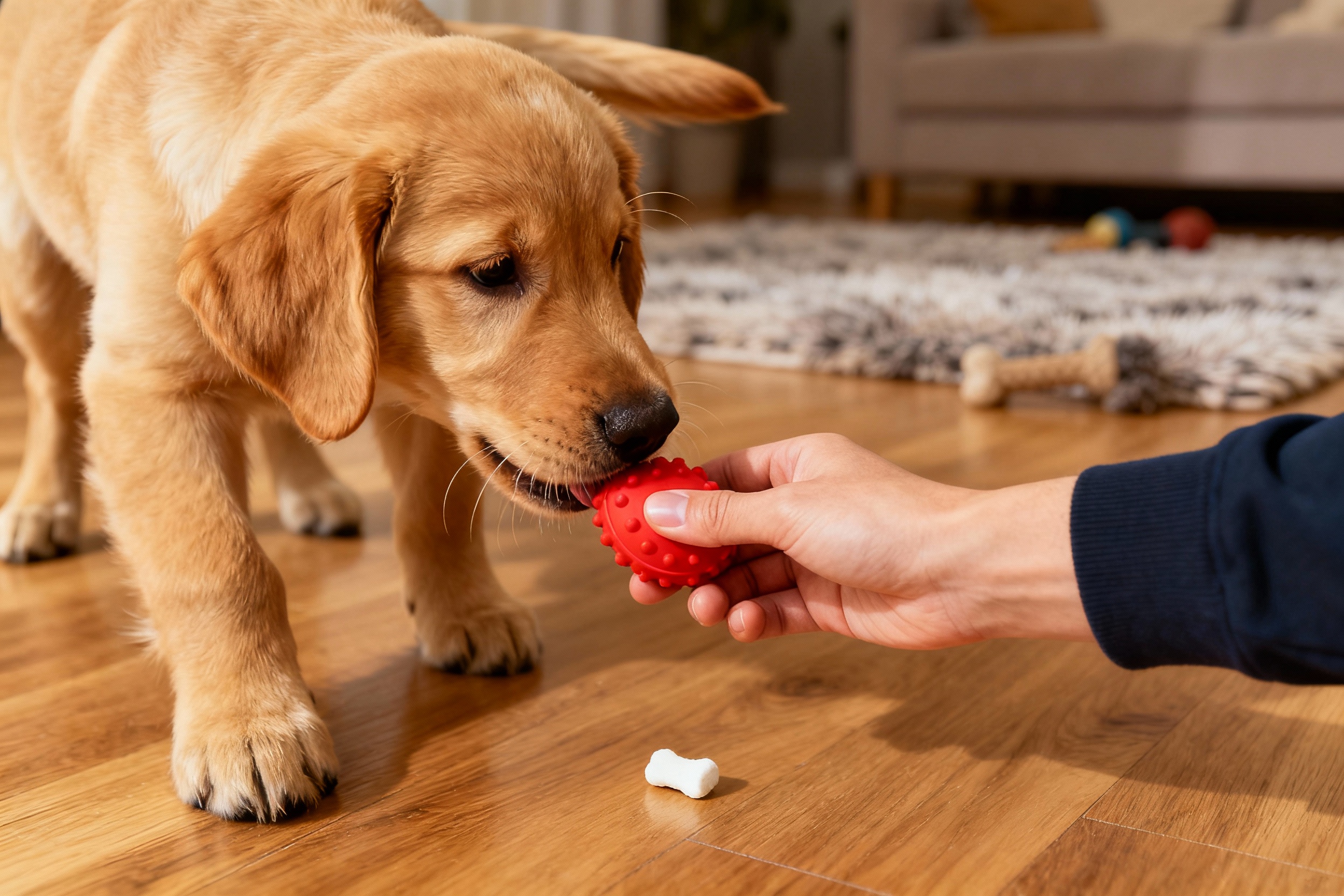
Puppy teeth are tiny shark teeth, and your hands are their favorite chew toys. Golden Retrievers learn with their mouths—so yes, the biting feels personal, but it’s not. The good news?
You can teach your golden fluffball to use a gentle mouth and keep your skin intact. Let’s get you a game plan so you can enjoy cuddles without Band-Aids.
Understand Why Your Golden Puppy Bites

Puppies bite because they explore the world with their mouths. They’re not being “bad”—they’re being babies.
Teething also ramps up mouthiness, especially between 12–20 weeks. For Goldens specifically: they’re mouthy by nature. They were bred to carry things gently, but they need guidance to learn that “gentle” part. So you don’t punish the instinct—you channel it.
Normal vs.
Problem Biting
Normal: nibbles during play, mouthing your hand when excited, chewing toys constantly. Problem: hard bites that leave marks, growling paired with stiff body language, or sudden biting out of nowhere. If the latter shows up, loop in a trainer.
Set Up Your Golden for Success
You’ll win this battle before it starts with smart prevention. Tired brain + busy mouth = fewer bitey moments.
- Daily bite outlets: Provide safe chew toys (rubber toys, puppy-safe Nylabones, rope toys) and rotate them so they stay exciting.
- Food puzzles: Kongs, lick mats, and snuffle mats work magic.
FYI, licking calms puppies.
- Short training sessions: 3–5 minutes, 3–5 times a day. Teach sit, down, and touch. Obedience trains the brain to think instead of chomp.
- Appropriate playmates: Well-matched puppy socials can teach bite inhibition faster than humans can.
Teething Relief
Freeze a wet washcloth (supervise), chilled puppy-safe teething rings, or a frozen stuffed Kong.
Cold reduces gum pain and biting intensity.

Teach Bite Inhibition (Gentle Mouth)
We’re not banning all mouth contact immediately. We’re teaching pressure control first—then we refine.
- Play calmly with your puppy. Offer your hand or a toy. If the puppy mouths softly, keep playing.
- If the bite gets hard, say “Ouch!” once (not dramatic) and immediately stop interaction.
Freeze for 2–3 seconds.
- Redirect to a toy. Offer a chew toy. When they bite the toy, mark it with a cheerful “Yes!” and resume play.
- Repeat relentlessly. Goldens connect patterns fast, but consistency is everything.
Why this works: Your puppy learns that hard bites end the party, gentle mouths keep it going. No lectures required.
When to Give a Time-Out
If your pup goes full piranha and ignores redirection:
- Calmly end play. Stand up, fold arms, no eye contact for 20–30 seconds.
- If needed, step behind a baby gate or place the pup in a safe pen for 1 minute.
This isn’t punishment—it’s a reset.
Redirect the Mouth—Every Time
Your mantra: “Mouth on toys.” You want your pup to choose toys without thinking twice.
- Scatter toys in every room. Make the right choice easy.
- Use tug as a reward. Tug is awesome for Goldens. If teeth brush your hand, pause the game. Dog moves teeth to tug?
Game on. IMO tug teaches control beautifully.
- Teach “Take it” and “Drop.” When your puppy grabs on cue and releases on cue, random biting drops big-time.
Teach “Leave It” (Super Useful)
- Hold a treat in your closed fist. Pup sniffs/licks?
Wait.
- The moment they back off, say “Yes!” and give a different treat from the other hand.
- Add the cue “Leave it” once they consistently disengage.
You’ll use this when your pup beelines for ankles, shoelaces, or your kid’s socks.

Manage Human Behavior (Yes, Yours)
We accidentally encourage biting all the time. Let’s stop doing that.
- Don’t roughhouse with hands. Use toys, always. Hands are for petting, not wrestling.
- Avoid squealing or flapping around. That reads as “WOO PARTY!” to a puppy.
- Keep greetings low-key. Ask for a sit before petting.
Reward calm behavior, not chaos.
- Coach kids. Short, gentle interactions only. No running, screaming, or tug-of-war with little humans. Supervise 100% of the time.
Reinforce Calm Like a Boss
Catch your puppy being good and pay up with praise or treats.
Lay on a mat? Reward. Chew a toy quietly?
Reward. The stuff you reward grows. Wild concept, I know.
Handle Biting During Zoomies and Witching Hour

Golden puppies get hyper bursts—typically early morning and evening.
That’s when biting spikes.
- Preempt with play. 5 minutes of tug or fetch before the zoomies helps.
- Leash indoors. Clip a lightweight leash to guide your pup away from ankles.
- Use a scatter cue. Toss kibble in the grass or on a snuffle mat to redirect the brain to foraging.
- Provide a chew-and-chill station. Crate with a stuffed Kong during peak gremlin time saves everyone’s nerves.
What Not to Do (Seriously, Don’t)
Some old-school advice refuses to die. Let’s bury it.
- No muzzle grabs, alpha rolls, or nose taps. These don’t teach bite control and can create fear or defensive aggression.
- Don’t punish growling. Growling communicates discomfort. Thank your pup for the info and adjust the situation.
- No painful deterrent sprays on hands. The goal is trust and guidance, not “my human tastes like pepper.”
Sample Daily Routine That Reduces Biting
Morning:
- Quick potty, then 5 minutes of tug or fetch.
- Breakfast in a puzzle feeder.
- 3-minute training: sit, down, touch.
Afternoon:
- Chew session with a frozen Kong.
- Short nap in a crate or pen (overtired pups bite more).
- Calm play with redirection to toys.
Evening:
- Sniff walk (let them explore).
- Zoomie management: structured play, then settle on a mat with a lick mat.
- Gentle petting when calm—reward that mellow golden energy.
FYI, a tired-but-not-overcooked puppy behaves best.
Overstimulation flips the bitey switch.
Progress Timeline and Expectations
You’ll see improvement within 1–2 weeks if you stay consistent. Full “gentle mouth” often lands by 5–6 months, depending on temperament. Some goldens mature slower; it’s not a failure, it’s a phase.
Stick with it, and keep sessions short, fun, and predictable. IMO consistency beats intensity every time.
FAQs
What if my puppy bites hard and draws blood?
Clean the wound, then review your setup. Hard bites mean the puppy feels overstimulated or under-managed.
Increase structured play, add time-outs for overarousal, and double down on toy redirection. If you see escalating intensity or stiff body language, consult a positive-reinforcement trainer.
Should I yelp like a puppy when they bite?
A brief “Ouch!” can work, but many puppies think it’s an invite to party harder. If your golden amps up, skip the yelp and go straight to calmly stopping play and redirecting to a toy.
The rule: emotion down, clarity up.
Will neutering/spaying stop biting?
Nope. Mouthiness stems from development, teething, and arousal, not hormones. Training, enrichment, and management fix biting.
Talk to your vet about timing surgery for health reasons, not behavior magic.
My puppy only bites my kids—why?
Kids move fast, squeal, and flail—aka “play me!” in dog language. Set up calm, short interactions with strict rules: no running, no roughhousing, toys only. Use gates and pens to separate during high-energy times and supervise always.
Is it okay to let my puppy chew on old socks or shoes?
Hard pass.
Puppies don’t know the difference between “old” and “new.” Give clear category lines: dog toys = yes, human stuff = no. Offer a trade if they nab a shoe—“Drop,” then reward and swap for a chew.
When should I get professional help?
If biting escalates, targets faces, includes guarding, or you see fear signals (freezing, hard stare, tucked tail), bring in a certified trainer who uses positive methods. Early help saves time, money, and stress.
Conclusion
Your golden isn’t trying to be a menace—they’re learning how to be a polite little land seal.
Give their mouth jobs to do, teach gentle feedback, and keep your cool when the shark mode appears. With consistency, you’ll trade nips for kisses and chaos for a dog who mouth-carries everything like a pro. And yes, your hands will survive.
Promise.
Leave a Reply