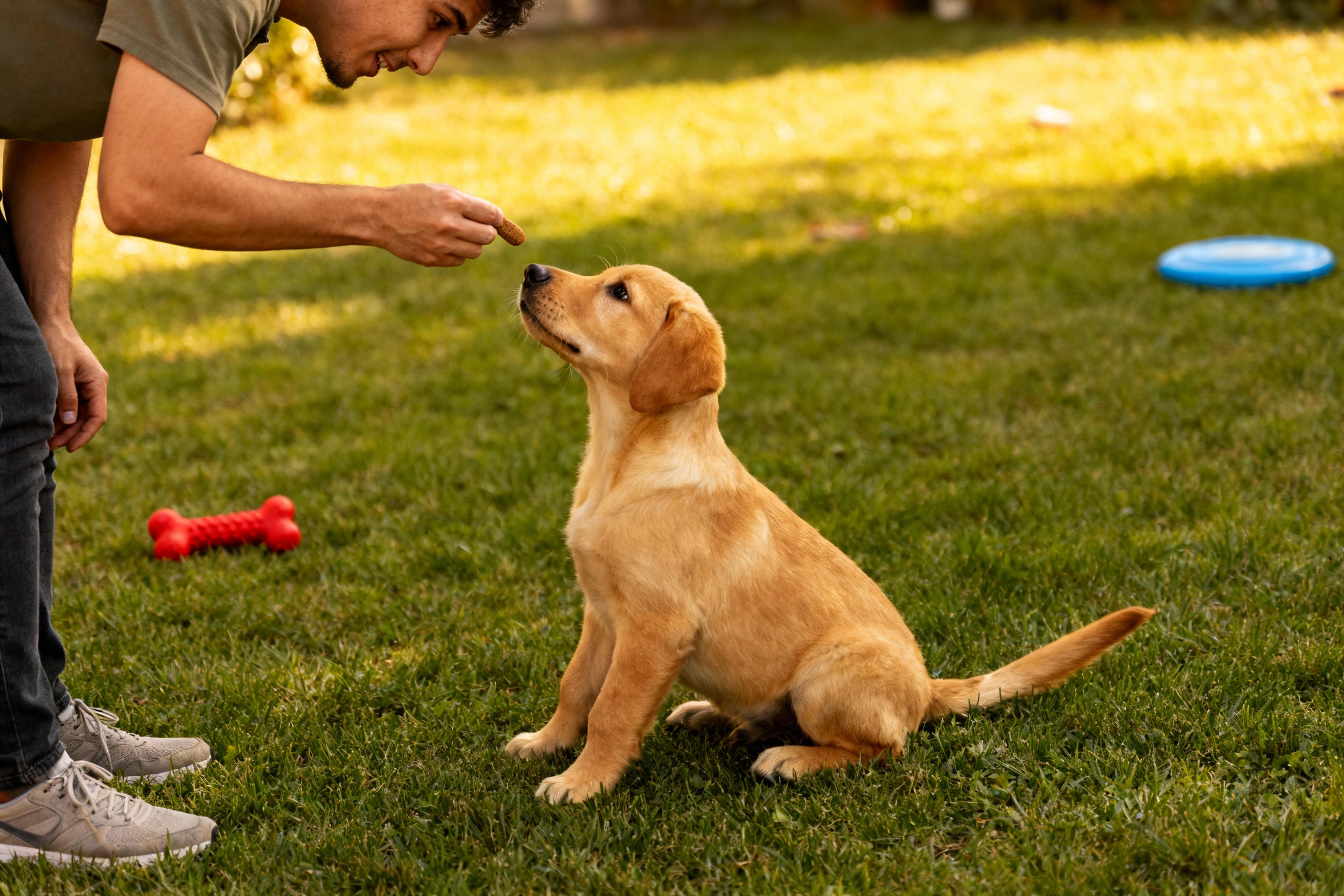
Your Labrador Retriever puppy looks at you like you hung the moon…and then eats your shoelaces. Welcome to Lab life. These dogs are smart, eager, and hilariously food-motivated—aka a dream to train if you set things up right.
Let’s skip the fluff and get you a plan that works, keeps your sanity intact, and turns that flailing tornado into a well-mannered sidekick.
Start With Day-One Rules (Yes, Even for Tiny Gremlins)
Decide the non-negotiables now. Couch or no couch? Free-roaming or gated?
Sleeping in a crate or your bed? Your puppy learns your house rules in about a week—unless you change them every other day. Set up your environment before pickup:
- Crate that fits now and includes a divider for growth
- Baby gates to block off rooms
- Chew toys with different textures
- Leash, harness, and a flat collar
- Treat pouch and bite-sized, smelly treats
Why so extra? Labs explore with their mouths.
Manage the environment and you’ll prevent 90% of “bad habits” from forming in the first place.
Potty Training Without Tears (Or Ruined Rugs)
You control the schedule, so you control the success. Take your puppy out:
- First thing in the morning and last thing at night
- After meals, naps, play, and excitement
- Every 60–90 minutes at first
When your pup pees outside, party like you won a game show. Treat within two seconds.
If accidents happen inside, just clean and move on. No scolding. Your puppy isn’t “being stubborn,” they’re just…a baby.
Crate Training the Easy Way
Make the crate a snack bar.
Feed meals there, toss treats in, and praise calm lounging. Start with short sessions and gradually add time. If they whine at night, take them out for a quick potty break, then back in.
Keep lights low and voices quiet—this isn’t social hour.
The First Five Cues: Keep It Simple, Keep It Fun
Forget fancy tricks. Teach the life skills that make a Lab enjoyable to live with. Do 2–3 minute sessions, several times a day.
- Name Response: Say their name once.
When they look at you, treat. Congrats, you’re now interesting.
- Sit: Lure the nose up, treat when the butt hits the floor. Use it for greetings, doors, and food bowls.
- Down: Lure from sit to the floor.
Helps with impulse control.
- Come (Recall): Start indoors on a long line. Say “come,” run backward, celebrate like a maniac when they arrive. Pay big every time.
- Leave It: Place a treat in your closed fist.
When your pup backs off, mark (“yes!”) and reward from the other hand.
Marker Words and Clickers
Use a consistent marker—“yes!” or a clicker—to pinpoint the exact moment your puppy does the right thing. It speeds up learning because your puppy knows what earned the reward. IMO, this is the single best training hack.
Bitey Crocodile Phase (And How to Survive It)
Labs teethe like it’s their job.
They’re not “aggressive”—they’re uncomfortable and overexcited. Teach polite mouths without turning into a chew toy. Do this trio religiously:
- Redirect to a chew toy or frozen Kong the second teeth touch skin.
- Stop play for 5–10 seconds after biting. Fun stops when teeth happen.
- Reward calm when your puppy chooses a toy or settles.
Chew Toy Rotation That Actually Works
Keep 5–7 options: rubber, rope, nylon, soft, and frozen.
Rotate daily to keep novelty high. FYI, frozen wet washcloths are clutch during peak teething weeks.
Leash Manners for a Dog That Won’t Dislocate You
Loose-leash walking beats being dragged like a kite. Start inside where distractions are low. Teach “follow the food” first:
- Hold a treat near your thigh and walk.
Feed every 2–3 steps if the leash stays loose.
- If they pull, stop. Don’t yank—just become a tree. When the leash loosens, move forward again.
- Reward heavily for checking in with you.
Eye contact = jackpot.
Level Up: The “Let’s Go” Cue
Say “let’s go” right before you change direction. When your pup turns with you, pay up. Your dog learns to watch you because you’re unpredictable and fun, not because you’re constantly correcting them.
IMO, that’s a better relationship.
Socialization: The Confidence Builder
The socialization window runs roughly until 16 weeks, and it matters. You’re not just introducing people and dogs—you’re building a resilient brain. Expose your puppy to:
- Different surfaces: grass, tile, gravel, wood, metal grates
- Sights and sounds: bikes, strollers, umbrellas, doorbells
- Handling: paws, ears, mouth, collar grabs, gentle restraint
Keep it positive. Pair new stuff with treats and praise.
If your puppy looks worried, back off, go slower, and shorten the session. Curiosity over confidence every time.
Dog Meetings Without the Drama
Leash greetings get messy. Choose calm, friendly adult dogs.
Keep leashes loose, make the intro short, and call your puppy away for a treat before things get rowdy. Your goal: quality over quantity.
Energy Management (Or: Prevent the 7 p.m. Zoomies)
Labs run like athletes and think like scientists.
If you don’t outlet both, you’ll get chaos. Split the day into short cycles. Daily rhythm idea:
- Morning: potty, 5-minute training, short sniffy walk
- Midday: food puzzle, nap in crate
- Afternoon: fetch in a hallway, “come” practice on a long line
- Evening: calm chew, gentle grooming, early bedtime
Tired brains beat tired bodies. Food puzzles, snuffle mats, and short training sessions burn energy smarter than endless fetch.
Common Pitfalls You Can Easily Dodge
Avoid these if you like sanity:
- Inconsistent rules: If “no couch” becomes “okay sometimes,” your Lab will negotiate like a lawyer.
- Late socialization: Waiting until full vaccinations to start exposure?
Do safe, controlled experiences now. Ask your vet for a plan.
- Overexercise: Growing joints need care. Use tons of free play and soft surfaces.
Save long runs for adulthood.
- Yelling for attention-seeking: Quietly remove attention, redirect, and reward calm choices.
- Using punishment: It can shut down learning and create anxiety. Teach what to do instead.
Food, Reinforcement, and Real-Life Rewards
Treats work. Period.
But don’t rely on them forever. Start with rapid-fire rewards, then fade to real-life paychecks. Mix it up with:
- Food for new skills and tough environments
- Toys and play for recalls and outdoor work
- Life rewards like door opens, off-leash time, or greeting friends
Once your puppy knows a cue, shift to a variable schedule—not every correct response earns a treat, but praise always does. Think slot machine, not salary.
FAQs
When should I start training my Labrador puppy?
Immediately.
Day one. Training at this stage looks like short games, gentle boundaries, and lots of rewards. You’re shaping habits more than teaching “obedience.”
How long can my puppy hold their bladder?
A rough guide is age in months plus one hour, up to about 4–5 hours.
Nighttime stretches run longer, but plan for at least one potty trip until your puppy matures.
My Lab chews everything—how do I stop it?
You won’t stop chewing—you’ll channel it. Puppy-proof your space, supervise, and trade forbidden items for approved chews. Offer variety and rotate toys to keep interest high.
Is group puppy class worth it?
Yes, with a reputable, reward-based trainer.
You’ll practice around distractions, learn timing, and get help with problem spots. Plus, your Lab gets safe exposure and structure. FYI, it also tires them out nicely.
When can I start off-leash training?
Start recall games now with a long line.
True off-leash freedom comes after you have a rock-solid recall around distractions. Safety first—especially with a curious, water-loving Lab.
How much exercise does a Labrador puppy need?
Think frequent, gentle bursts: several 10–15 minute sessions of play and sniffy walks, plus mental work. Skip forced running or jumping until growth plates close (around 12–18 months).
Wrapping It Up: Raise the Dog You Want to Live With
Set clear rules, pay the behaviors you love, and prevent the ones you don’t.
Keep training sessions short, upbeat, and frequent. Socialize widely, exercise smart, and protect those growing joints. Do that, and your Labrador won’t just be “well-behaved”—they’ll be the fun, confident partner you brag about.
IMO, that’s the best kind of flex.
Leave a Reply