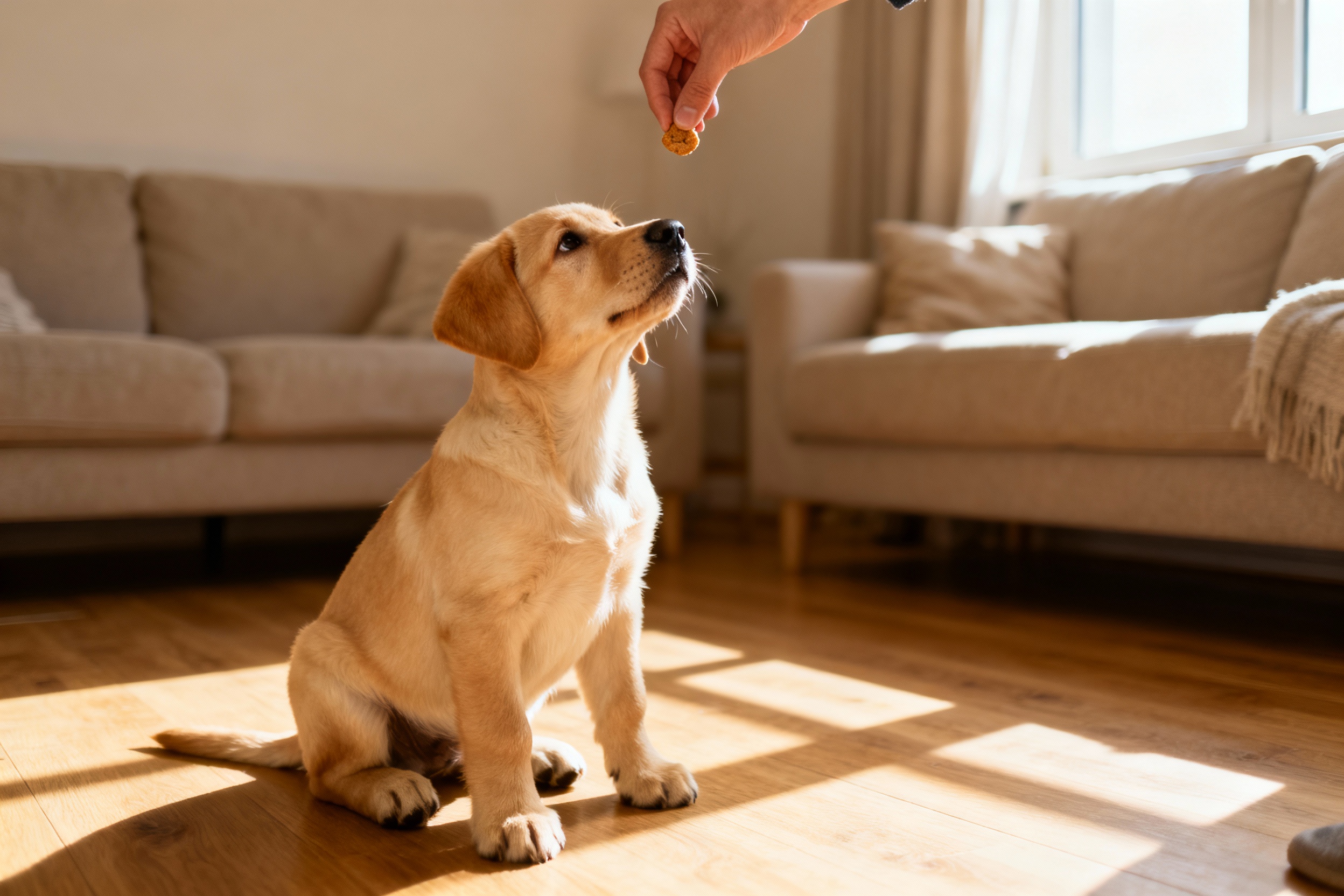
Your Labrador puppy didn’t come with an instruction manual, but good news: you don’t need one. You need snacks, patience, and a plan. Labs learn fast, love hard, and chew everything within paw’s reach.
Let’s turn that adorable chaos into a well-trained buddy who listens, settles, and doesn’t treat your shoes like appetizers.
Set Up Your Home Training Zone
Before you teach any cues, control the environment. You can’t coach focus if your Lab puppy roams like a sugar-fueled toddler at a carnival.
- Crate: Choose a wire crate with a divider so the puppy can’t party in one corner and potty in the other. It becomes their safe den, not a jail.
- Playpen: Gate off an area for supervised free time.
Chew toys in, electrical cords out.
- Potty spot: Pick a specific outdoor area. Consistency makes everything click faster.
- Gear list: Flat collar, front-clip harness, 6-foot leash, high-value treats, food puzzle toys, a chew buffet (nylon bone, rubber toys).
House Rules From Day One
Decide how you want adult-dog behavior to look. Couch or no couch?
Bedroom or not? Begging allowed? (Hint: no.) Train for the future dog you want by enforcing those rules now, not “when they’re older.”
Potty Training Without Tears (Or Carpets)
Labrador puppies have small bladders and big opinions. You’ll win with a tight schedule and relentless consistency.
- Take out often: First thing in the morning, after naps, after meals, after play, and every 1–2 hours.
- Go to the same spot: Stand still.
Quietly wait. The smell cues them to go.
- Celebrate: The instant they finish, jackpot treats + praise. Not after you go back inside.
Timing matters.
- Accident protocol: No scolding. Clean with enzyme cleaner. Supervise better next time.
- Night routine: Limit water 2 hours before bed, last potty break, then straight to crate.
Crate Training That Doesn’t Feel Mean
Make the crate magical.
Feed meals inside. Toss a few treats in first. Short sessions with the door open, then closed for 1–3 minutes, then longer. Release while they’re quiet, not when they’re crying.
You’re teaching calm, not karaoke.
The Big Four: Name, Sit, Down, Come
Start with simple cues so you and your pup rack up wins. Labs adore winning.
Name Recognition
Say their name once, wait for eye contact, yes/treat. Don’t turn their name into background noise.
Say it with purpose.
Sit
Lure the nose up, reward as soon as the butt hits the floor. Use sit for everything: doors, meals, leashes. Life rewards beat food sometimes.
Down
From sit, lure straight down between paws. Keep it calm.
Reward on the floor, not in the air.
Recall (Come)
Start indoors with zero distractions. Say “Come!” once, crouch, open arms, celebrate like a party. Reward big.
If they ignore, your paycheck (treats) isn’t high enough. IMO, recall is your emergency brake—pay well.
Leash Skills: Stop the Sled-Pulling
Your Lab pup thinks walking means fast-forward. We’ll fix that with clear rules and a little patience.
- Front-clip harness: It reduces pulling power without choking.
- Plant-and-pivot: When the leash tightens, stop.
Call them back, treat at your side, then move again. Consistency beats strength.
- Reward position: Deliver treats by your thigh to build a “heel zone.”
- Micro-walks: Practice in your hallway before tackling squirrels and joggers.
Loose-Leash Games
Make it fun so your Lab buys in.
- Find It: Drop a treat behind you when they forge ahead. They check in more.
- Red Light/Green Light: Walk when the leash is slack, freeze when it’s tight.
Dogs learn “pressure stops the fun.”
Bitey Land Shark Phase (And How To Survive It)
Puppies mouth. Labs mouth with extra enthusiasm. You’ll redirect, not punish.
- Offer legal chews: When teeth land on skin or clothes, calmly swap for a chew toy.
- End the game: If they escalate, stand up and go neutral for 10–20 seconds.
Boring ends biting.
- Frozen washcloths: For teething relief. Monitor, don’t let them shred.
- Teach “Drop” and “Leave it”: Cue “Drop,” trade with a treat, give the item back sometimes so they don’t play keep-away.
Impulse Control 101
Teach “Wait” at doors and for food bowls. Bowl goes down only when they sit and hold it.
Lift it if they pop up. Two seconds today becomes thirty seconds next month. FYI, impulse control solves 80% of your chaos.
Socialization: The Confidence Builder
You don’t just introduce your puppy to the world. You teach them the world feels safe and awesome.
- People and dogs: Friendly, vaccinated, and calm partners only.
Quality over quantity.
- Surfaces and sounds: Metal grates, umbrellas, skateboards, vacuums. Pair each with treats.
- Handling practice: Touch paws, ears, mouth, tail. Treat each touch.
Your future vet will thank you.
- Car rides and vet vibes: Short rides end in fun places. Drop by the clinic for a weigh-in and cookies only.
Red Flags To Watch
If your puppy freezes, growls, or hides, back off. Lower intensity, increase distance, add treats. Flooding doesn’t build confidence; it creates anxiety.
Go slow.
Brain Work: Tire the Mind, Save the Sofa
Labs need jobs. If you don’t assign one, they’ll freelance. Badly.
- Food puzzles: Kongs, snuffle mats, slow feeders.
Work for meals, don’t just hand them over.
- Training sprints: 3–5 minute sessions, 3–6 times daily. Short and sweet beats long and boring.
- Simple scent games: Hide treats around a room. Say “Find it!” and cheer the nose.
- Retrieve with rules: Ask for sit, toss once, ask for “Drop,” reward calm.
No fetch marathons with baby joints.
Protect Those Growing Joints
Keep forced exercise low until growth plates close (around 12–18 months). Avoid long runs and jumping off furniture. Play on grass, not concrete.
Your future adult dog will move like a dream, IMO.
Common Mistakes (And Easy Fixes)
We all mess up. Correct fast and you’ll be fine.
- Repeating cues: “Sit sit sit sit” teaches ignoring. Say it once, then help with a lure.
- Training when they’re wired: Overexcited puppies can’t learn.
Burn energy with a sniffy walk first.
- Late rewards: You get what you pay for immediately. Deliver within 1–2 seconds.
- Too much freedom: Freedom is earned. Expand access room by room after consistent success.
Sample Daily Schedule
Use this as a template, not gospel.
Adjust to your life and puppy’s bladder.
- 7:00 AM: Potty, breakfast in puzzle toy, short training (name + sit)
- 8:00 AM: Sniffy walk, leash practice
- 9:00 AM: Nap in crate
- 11:00 AM: Potty, play, training (down + drop)
- 12:30 PM: Lunch, chew time, nap
- 3:00 PM: Potty, socialization field trip (parking lot people-watching)
- 5:30 PM: Dinner, impulse control (wait at bowl)
- 7:00 PM: Gentle play, settle on mat, grooming/handling
- 9:30 PM: Last potty, quiet crate time
FAQ
How long can my Labrador puppy hold their bladder?
Rule of thumb: their age in months plus one equals hours, max. A 3-month-old can manage around 4 hours during the day. Night stretches run longer, but don’t push it.
Fewer accidents means faster training.
What treats work best for training?
Use soft, pea-sized treats that don’t crumble. Think chicken bits, cheese, or store-bought training treats. For tough moments (recall!), bring the big guns—boiled chicken or freeze-dried liver.
Pay more for harder tasks.
When should I start formal training classes?
As soon as your vet clears you, usually after the first set of vaccines. Puppy classes add safe socialization and teach you handler skills. Choose a trainer who uses positive reinforcement and allows supervised play, not chaos.
My puppy bites a lot.
Is that normal?
Totally. Teething + curiosity = mouthy gremlin. Redirect, offer chews, end play if they escalate.
Consistency reduces biting by the 5–6 month mark. If they guard items or bite hard, contact a qualified trainer early.
How much exercise does a Lab puppy need?
Short, frequent play sessions and sniffy walks beat long hikes. Aim for 5 minutes per month of age, twice daily, plus mental work.
Keep jumping and forced running off the menu until they mature.
What commands should I prioritize?
Focus on name, sit, down, come, drop, leave it, and wait. These cues keep your life sane and your puppy safe. Fancy tricks can wait; impulse control can’t.
Conclusion
Training your Labrador puppy at home doesn’t require perfection—just structure, timing, and a sense of humor.
Keep sessions short, reward generously, and guard your shoes like crown jewels. With smart socialization and clear rules, your bouncy Lab turns into the reliable sidekick you pictured. And yes, that day you drink hot coffee while your dog settles calmly at your feet?
It’s coming.
Leave a Reply