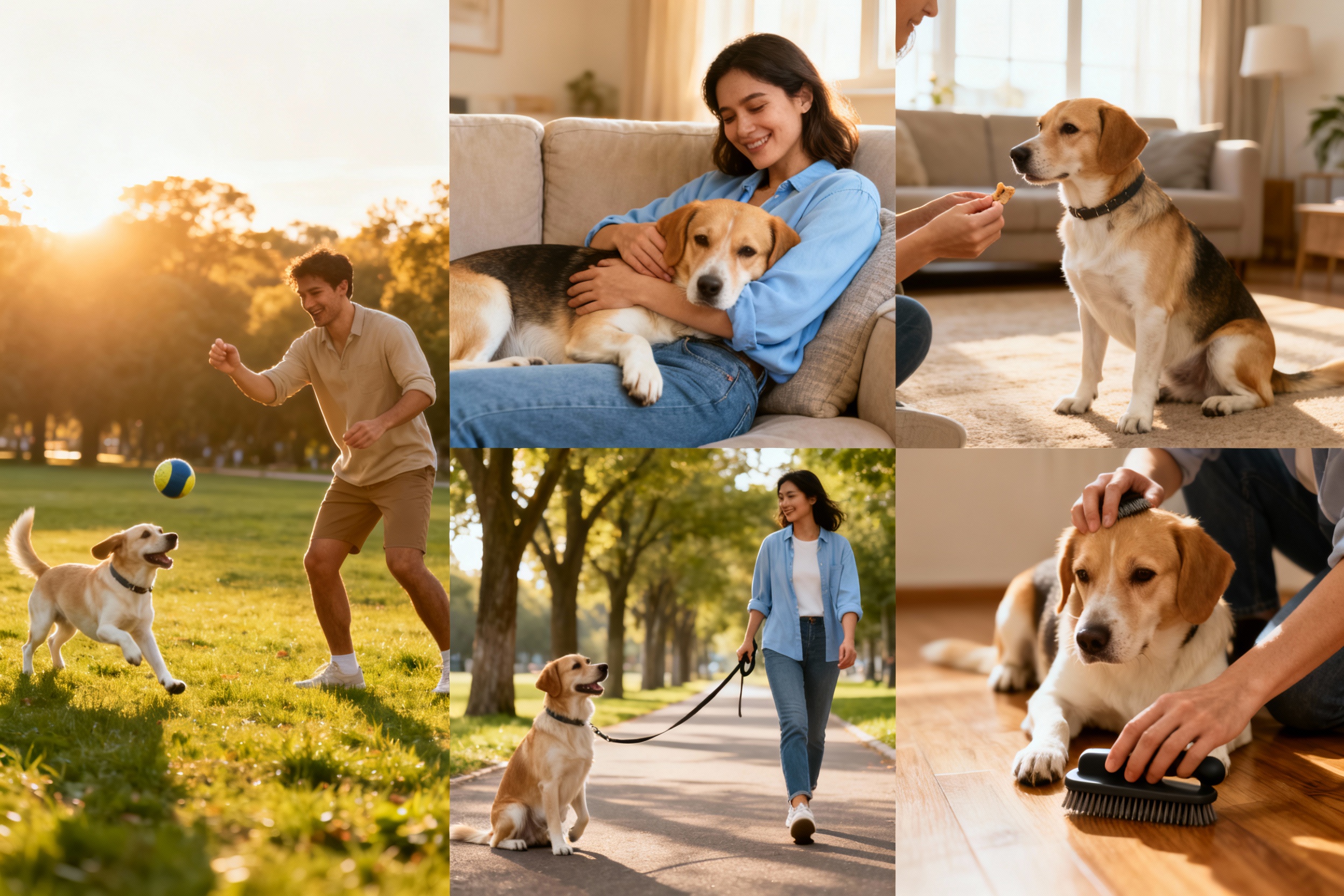
You brought home a new dog. Congrats! Now what?
You’re both staring at each other like roommates who never discussed who gets the good side of the couch. Let’s fix that. Bonding with your dog doesn’t require mystical wolf-moon rituals.
It takes daily moments, a little structure, and a lot of snacks.
Start with a Routine (Your Dog Loves Predictable)

Dogs thrive on patterns. When you feed, walk, and play at roughly the same times every day, your dog relaxes and starts to trust you. Predictability screams, “You’re safe here and I’ve got you.”
- Set simple anchors: Morning potty break, midday play or walk, evening chill time.
Keep these consistent.
- Use small rituals: A phrase before walks (“Ready?”), a quick sit before meals, a bedtime chew. Little rituals build big trust.
- Keep greetings low-key: Don’t turn arrivals into a circus. Calm greetings prevent anxiety and teach your dog that you always come back.
How long before a routine sticks?
Most dogs settle into a groove in about 2–3 weeks.
Some need longer, especially rescues who bounced around. Stay patient. Things click faster when you keep changes minimal at first.
Train Together (Short Sessions, Big Payoff)
Training bonds you faster than snuggling ever could.
Why? It speaks your dog’s language. You set clear rules, reward good choices, and your dog learns you’re worth listening to.
- Go tiny and frequent: 5–10 minute sessions, 2–3 times a day.
End before your dog gets bored.
- Start easy: Name recognition, sit, down, touch/target, and recall. These build focus and confidence.
- Use high-value rewards: Soft treats, small pieces. Mix in praise and play.
Pay well for good work—this isn’t unpaid internship season.
Make “Come Here” your superpower
Practice recall indoors first. Say your recall word once (not a nag-fest), back up, cheer, reward like crazy when your dog hits your feet. Level up to a long line in quiet parks.
Recall saves lives and wins hearts—IMO it’s the #1 bonding skill.

Play Their Game (Not Just Yours)
You probably want fetch. Your dog might want tug, sniffing games, or “zoomies with a side of chaos.” Meet them where they’re at. When you play the games your dog loves, you become the Fun Human.
- Tug builds teamwork: Use a sturdy tug toy, teach “take it” and “drop,” and keep games controlled.
Tug tires the brain, not just the body.
- Fetch? Maybe: Some dogs fetch like Olympic athletes. Others chase once and judge you.
Try rolling, not throwing, to build interest.
- Sniffing = dog Netflix: Hide treats around a room, let your dog “find it.” You’ll see them relax and focus, which bonds you hard.
Play rules that keep it fun
– Keep sessions short and end while your dog still wants more. – Insert quick cues (“sit,” “drop”) to build self-control. – If arousal spikes (zoom-biting, wild eyes), pause for a sniff break.
Get Outside and Explore Together
Walks aren’t just potty breaks. They’re how your dog reads the neighborhood newsletter. You both bond when you go places together and handle the world as a team.
- Sniff walks beat power walks: Let your dog set the pace sometimes.
Sniffing drains stress better than yanking through miles.
- Use a well-fitted harness: Reduce pulling pressure and avoid neck strain. Your leash arm will thank you.
- Vary the route: New smells, new sights, new confidence. Little adventures cement trust.
Nervous dog strategy
Choose quiet routes.
Reward check-ins. Keep distance from triggers (bikes, loud kids, other dogs) until your pup feels steadier. You’re the safe base—prove it consistently.

Communicate Like a Dog (Well, Almost)
Your dog reads your body more than your words.
You’ll bond faster if you listen to their body language and keep yours clear.
- Learn the basics: Soft eyes, loose body, wagging at mid-height = comfy. Licked lips, yawns, head turns, tucked tail = stressed. FYI, not every wag means happy.
- Use calm motions: Stand sideways, crouch, avoid looming.
Invite your dog in; don’t grab or hover.
- Mark good choices: “Yes!” or a clicker the instant your dog does what you want. Timing matters more than volume.
Affection on their terms
Some dogs love chest rubs. Others prefer gentle ear strokes or just hanging out nearby.
Do the “consent test”: pet for 3 seconds, stop, and see if your dog leans in or walks away. Respect the answer—IMO that respect builds trust faster than any treat.
Create a Cozy Home Base

Your dog needs a place to exhale. A comfy den reduces anxiety and gives you a reliable reset button.
- Pick a quiet spot: Away from heavy foot traffic.
Add a bed or crate with a cover for a den-like vibe.
- Chews and enrichment: Stuffed Kongs, lick mats, long-lasting chews. Licking and chewing soothe the nervous system.
- House rules = clarity: Decide early: couch or no couch? Bedroom or not?
Inconsistency confuses dogs and slows bonding.
Crate training cliff notes
– Feed meals in the crate, door open at first. – Toss treats inside, praise calmly when your dog enters. – Short, positive reps. Never use the crate as punishment. – Build duration slowly—think minutes, not hours, at the start.
Feed the Relationship (Literally)
Food makes friends. Use mealtimes to build connection and manners.
- Hand-feed a portion: Especially during the first two weeks.
Ask for a sit, deliver a few kibbles, repeat. Eye contact happens naturally.
- Puzzle meals: Snuffle mats, slow bowls, or scatter feeding in the yard keep brains busy and reinforce calm.
- Trade games: Teach “take” and “trade” early. Offer a high-value treat for whatever’s in their mouth.
This reduces guarding and builds trust.
Common Mistakes That Kill the Vibe
- Too much too fast: Parties, dog parks, road trips—hard pass for the first few weeks. Let your dog decompress.
- Inconsistent rules: Sitting sometimes for the leash but not always? Your dog can’t read your mind, unfortunately.
- Rough handling: Don’t drag, corner, or force cuddles.
Invite, and wait.
- Skipping decompression: New dogs need naps. Lots of them. Overstimulated dogs act “naughty”; tired brains can’t learn.
FAQ
How long does it take to bond with a new dog?
You’ll feel a shift within a couple of weeks if you keep things consistent.
Real trust often lands around the three-month mark. Rescue dogs who experienced stress may need longer. Keep showing up with routine, play, and patience.
Should I let my new dog sleep in my bed?
It depends on your boundaries and the dog.
If house training still needs work or your dog guards space, start with a bed or crate nearby. You can always upgrade later. Changing the rule the other way around is harder.
What if my dog doesn’t seem to like me yet?
Don’t take it personally.
Give space, use hand-feeding, keep sessions short and positive, and avoid flooding them with attention. Let your dog approach you. Earned trust beats forced affection every time.
Do I need a trainer right away?
If you’re dealing with fear, reactivity, resource guarding, or anything that worries you, yes—get a certified trainer who uses modern, reward-based methods.
Otherwise, DIY basics at home work great. A few pro sessions can fast-track your bond.
Is the dog park a good bonding tool?
Not for most new dogs. Unpredictable dogs in a chaotic space can overwhelm your pup and wreck your recall.
Try one-on-one playdates with a known, friendly dog or stick to sniffy walks and training games instead.
How much exercise does my dog really need?
Breed, age, and temperament matter. As a rule of thumb, mix physical exercise with mental work each day. Ten minutes of training or sniff work can tire a dog more than a 30-minute walk.
Watch behavior afterward—calm and relaxed means you hit the sweet spot.
Conclusion
Bonding with your new dog isn’t a grand gesture; it’s a bunch of small, consistent moments. Build a routine, train a little, play their favorite games, explore together, and listen to what their body language says. Do that, and you’ll turn “new roommate” energy into “ride-or-die bestie” before you finish that first big bag of kibble.
FYI: snacks help. Always.
Leave a Reply